Dermal Peptide · Checked
SNAP-8
Every price, divided down to the milligram.
Sticker prices hide what a compound actually costs, because vial sizes differ. So we divide the listing by its stated peptide content and show the real cost per milligram.
Vendors pay us a commission when you buy through our links. It never changes the order — rows are sorted by measured price per mg, and every flag is computed from the data shown. Read the full disclosure
Where to buy
One listing trackedHow this page is funded: vendors listed here pay us a commission when you buy through our links. Commissions never change the ranking — rows are ordered by measured price per mg, and flags are computed from the data on this page. Sponsored placements, if any, are always labeled.
On this page
How to read these rows
Verify the COA
A certificate of analysis should come from an independent lab, reference the exact batch number on the label, and be recent. Vendor-issued documents without a named third-party lab carry less weight — the COA row links to what each vendor publishes.
Match the format
Lyophilized vials and sprays are different products with different concentrations. That is why sprays sit outside the $/mg ranking — compare vials to vials, sprays to sprays.
Count the total cost
Shipping fees, free-shipping thresholds and active discount codes can flip which vendor is actually cheapest for your order size. The $/mg figure is the baseline; the shipping and code details finish the math.
How we rank
The row below carries a price per mg figure: listed price divided by stated peptide content, excluding shipping and codes. It is the same calculation applied on every compound page, so a figure here is directly comparable to one anywhere else on the site.
We currently track a single listing for this compound. When a second vendor is added the rows are ordered by measured $/mg, and the flags for testing and shipping are computed from the data shown. Each row carries its own verification date.
About SNAP-8
Trademark
SNAP-8™ is a registered trademark of Lipotec. Suppliers of the branded material state that the mark cannot be used in marketing material without a signed trademark agreement.
Storage and handling
- Appearance
- white to off-white lyophilized powder
- Solubility
- highly water-soluble
- Storage, short-term
- 2–8 °C
- Storage, long-term
- −20 °C, dry, protected from light and moisture
Formula derivation
The eight constituent residues sum to C39H81N15O23S. Removing seven waters for the seven peptide bonds gives C39H67N15O16S. Adding the N-terminal acetyl group gives C41H69N15O17S, and converting the C-terminal carboxyl to a carboxamide gives C41H70N16O16S at 1075.16 g/mol.
Relationship to Argireline
SNAP-8 is Argireline with two additional residues. That is the whole structural story, and it is the single most useful thing to know about the compound.
Argireline (Acetyl Hexapeptide-8)
Ac-Glu-Glu-Met-Gln-Arg-Arg-NH2 6 residues
SNAP-8 (Acetyl Octapeptide-3)
Ac-Glu-Glu-Met-Gln-Arg-Arg-Ala-Asp-NH2 8 residues
The first six residues are identical. SNAP-8 extends the chain with alanine and aspartate, tracking two residues further along the N-terminal sequence of SNAP-25.
Both are marketed by Lipotec. Argireline is the earlier and more extensively studied of the two; SNAP-8 is described by the manufacturer as the elongated successor.
Naming caution: Acetyl Hexapeptide-8 and Acetyl Octapeptide-3 are different compounds despite the similar INCI construction. Acetyl Hexapeptide-8 is also encountered as Acetyl Hexapeptide-3, an older designation for the same hexapeptide. Literature on one does not transfer to the other.
The SNARE complex
SNARE (soluble N-ethylmaleimide-sensitive factor attachment protein receptor) is the protein assembly that mediates fusion of synaptic vesicles with the presynaptic membrane. Three proteins form the core:
Syntaxin membrane-anchored target protein Synaptobrevin vesicle-associated membrane protein (VAMP)
Assembly of these three brings vesicle and target membranes into apposition, permitting fusion and release of vesicle contents, including acetylcholine at the neuromuscular junction and catecholamines from chromaffin cells.
How SNAP-8 is described in the literature
SNAP-8 reproduces the N-terminal segment of SNAP-25 and competes with full-length SNAP-25 for its position in the assembling SNARE complex.
Because the fragment cannot perform SNAP-25's full structural role, incorporation destabilizes the complex. A destabilized SNARE assembly supports vesicle fusion less efficiently, reducing neurotransmitter release and attenuating the muscle contraction that follows.
In the dermatological context, the endpoint measured is reduced intensity of repeated facial muscle contraction, and therefore reduced depth of dynamic expression lines.
Comparison with botulinum toxin
Both act on the same vesicle-fusion machinery but by different means.
Botulinum neurotoxin is a protease that cleaves SNAP-25. SNAP-8 is a peptide fragment that competes for a position in the complex. The mechanisms converge on reduced neurotransmitter release; the molecular events are unrelated.
Fragment-based research use
Outside cosmetic contexts, SNAP-8 is used as a defined sequence fragment for probing SNARE domain interactions, protein-protein recognition, and structure-function relationships — the standard fragment-based approach of using a short defined segment to interrogate the behaviour of a larger protein.
Manufacturer data (Lipotec)
Reduction in severity of periorbital wrinkles of up to 63.13% in clinical testing. In-vivo and in-vitro comparison described as approximately 30% greater activity than Argireline.
Independent and peer-reviewed literature
Topical formulations containing SNAP-8, generally in combination with other peptides such as palmitoyl tripeptide-5, have reported wrinkle depth reductions in the range of 25–35% over several weeks. A 12-week study of a combination serum reported a 26% reduction in periorbital wrinkles.
A separate 12-week facial serum study reported improvements in skin firmness (11%), elasticity (18%) and texture (47%), with 43% of subjects reporting improvement in overall facial appearance. These were combination formulations, so the contribution attributable to SNAP-8 specifically is not isolated.
A pilot study of topical Acetyl Hexapeptide-8 — the parent hexapeptide, not SNAP-8 — in blepharospasm patients receiving botulinum neurotoxin therapy reported prolonged symptom control in some subjects (Lungu et al., 2012).
The gap between the manufacturer's 63% figure and the 25–35% range in independent literature is the notable feature of this evidence base. The higher figure derives from manufacturer testing under optimized conditions and has not been independently replicated.
Formulation data
Relevant where the material is used as a topical ingredient rather than a bare research peptide.
INCI (branded solution) : Water, Acetyl Octapeptide-3, Caprylyl Glycol Active content : the branded solution is supplied at 0.05% Acetyl Octapeptide-3 Recommended usage rate : 3–10% of the finished formulation Incorporation : add at cool-down, at the end of the emulsion, below 40 °C (104 °F) Appearance (solution) : clear water-like liquid, odourless Solubility : water-soluble Storage (solution) : refrigerate at 4 °C (39 °F) Note : refrigerated storage can occasionally cause precipitation of the preservative without affecting product integrity Formats : suitable for emulsions, gels and serums
Supply-size context
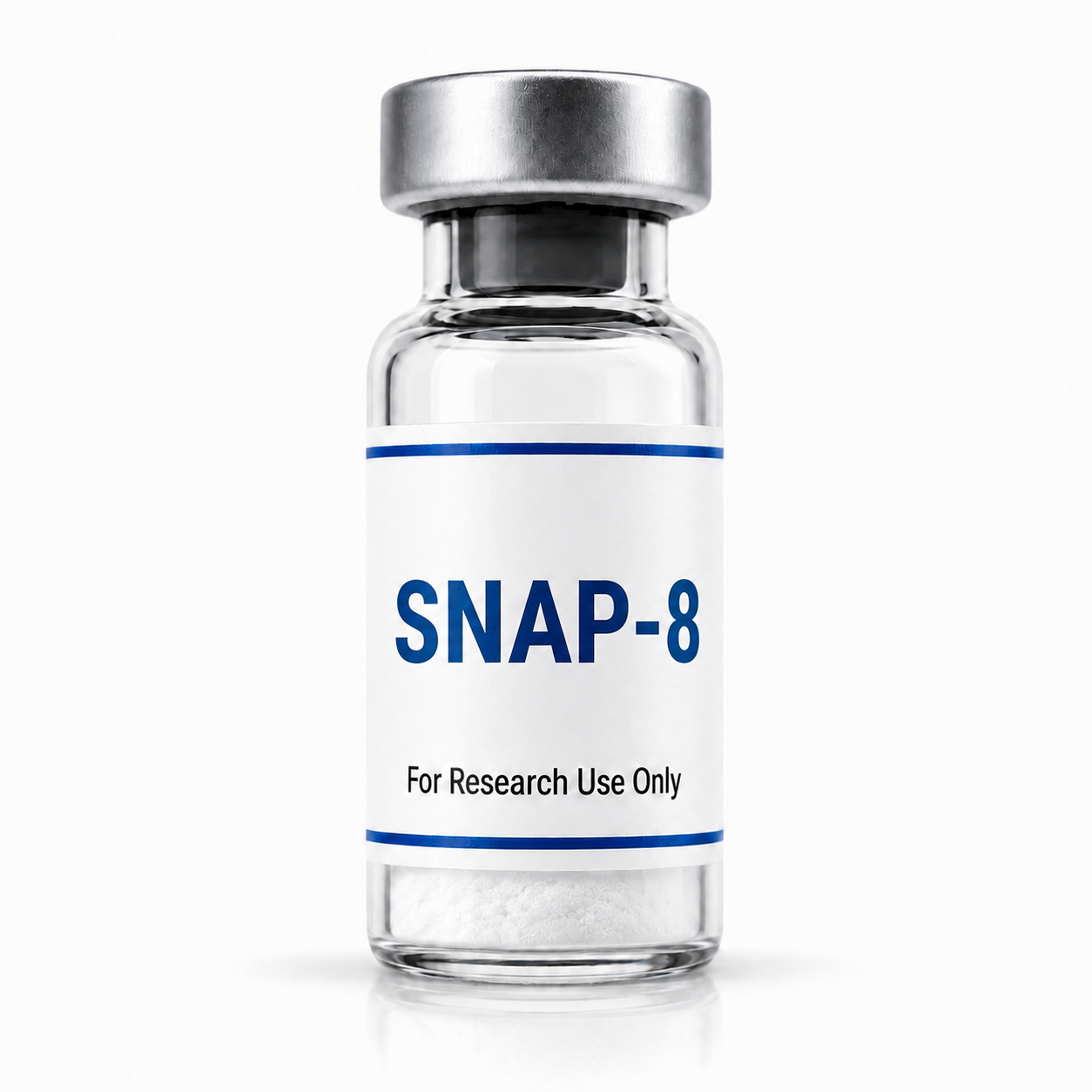
The compound is sold both in 10 mg research vials and in 200 mg quantities alongside other topical actives such as Matrixyl and GHK-Cu, reflecting its use as a formulation ingredient rather than as an injectable research peptide.
Regulatory status
SNAP-8 is not approved by the FDA for cosmetic, medical, or injectable use. It is used as a cosmetic ingredient under the INCI designation Acetyl Octapeptide-3, which is an ingredient nomenclature rather than an approval.
There are no clinical safety evaluations supporting human application beyond topical cosmetic use. Material supplied for laboratory use is a research chemical. It is not a drug, food, cosmetic, or dietary supplement as supplied, and is not intended for human or veterinary use.
Specifications
| Attribute | Value |
|---|---|
| Molecular formula | C41H70N16O16S |
| Molecular weight | 1075.16 g/mol |
| CAS Number | 868844-74-0 |
| PubChem CID | 86080331 ↗ |
| INCI name | Acetyl Octapeptide-3 |
| Former INCI name | Acetyl Glutamyl Heptapeptide-1 |
| Residue count | 8 |
| Sequence | Ac-Glu-Glu-Met-Gln-Arg-Arg-Ala-Asp-NH2 |
| One-letter | Ac-EEMQRRAD-NH2 |
| Structure class | linear synthetic octapeptide, |
| Origin | N-terminal domain of SNAP-25 |