Synthetic Peptide Compounds · Checked
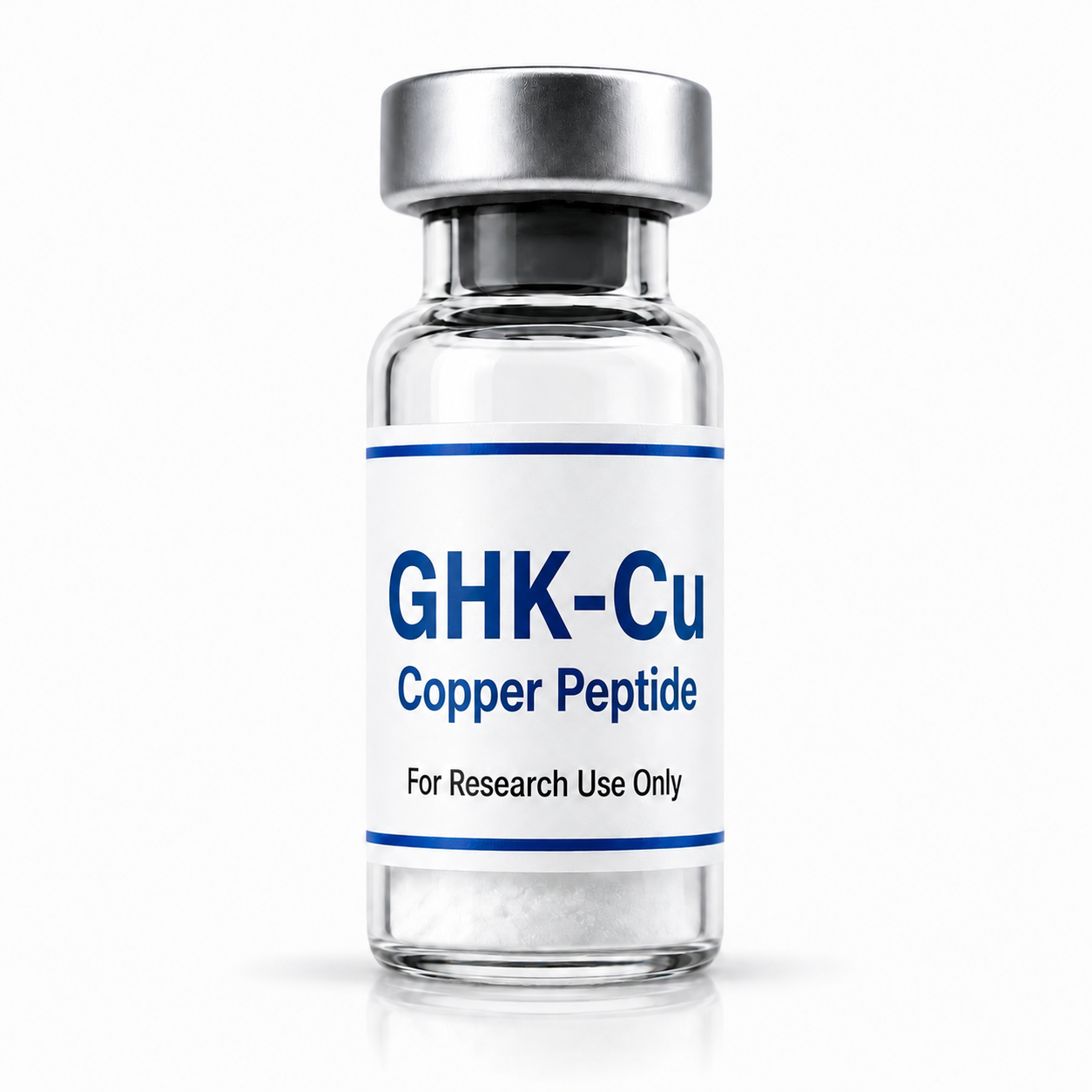
GHK-Cu
Every price, divided down to the milligram.
Vendors sell this compound in different vial sizes at different prices, which makes sticker prices useless for comparison. So we divide every listing by its stated peptide content and rank what comes out.
Vendors pay us a commission when you buy through our links. It never changes the order — rows are sorted by measured price per mg, and every flag is computed from the data shown. Read the full disclosure
Ranked by $ per mg
Sprays listed after the vials, unrankedHow this page is funded: vendors listed here pay us a commission when you buy through our links. Commissions never change the ranking — rows are ordered by measured price per mg, and flags are computed from the data on this page. Sponsored placements, if any, are always labeled.
On this page
How to read these rows
Verify the COA
A certificate of analysis should come from an independent lab, reference the exact batch number on the label, and be recent. Vendor-issued documents without a named third-party lab carry less weight — the COA row links to what each vendor publishes.
Match the format
Lyophilized vials and sprays are different products with different concentrations. That is why sprays sit outside the $/mg ranking — compare vials to vials, sprays to sprays.
Count the total cost
Shipping fees, free-shipping thresholds and active discount codes can flip which vendor is actually cheapest for your order size. The $/mg figure is the baseline; the shipping and code details finish the math.
How we rank
Rows are ordered by price per mg: listed price divided by stated peptide content, excluding shipping and codes, so every vial competes on the same axis. Each row carries its own $/mg figure, so the size of the gap between vendors is visible, not just the order. Sprays follow the vials, unranked.
The best-documented testing flag goes to the vendor publishing batch-level, third-party certificates. The shipping flag goes to the fastest published delivery from a domestic warehouse. Data is re-checked on a schedule and each row carries its verification date.
Copper-tripeptide skin & tissue-remodelling molecule
Copper peptide GHK-Cu — the gold standard for collagen synthesis, skin regeneration, and senescence research.
A copper-chelating 3-residue peptide (Gly-His-Lys) that binds Cu²⁺ with high affinity. Characterised in the primary literature as a modulator of DNA gene-expression signatures related to tissue remodelling and copper transport. For laboratory characterisation only.
GHK-Cu — clinical & mechanistic profile
GHK-Cu is a naturally occurring copper-binding tripeptide that regulates over 4,000 genes involved in peptide research, collagen synthesis, and anti-inflammatory responses. 2025-2026 research confirms it delivers bioavailable copper, resets cellular gene expression to a younger-marker state, reduces IL-6/TNF-alpha, supports DNA repair via 84 anti-cancer-related genes, and shows cumulative collagen remodeling with 3-6 months of use.
Studied applications
- Gene expression modulation
- studied for effects on over 4,000 genes affecting regeneration and inflammation
- Wound healing
- investigated in dermal repair, with topical applications better characterized than systemic
- Skin aging
- researched for collagen/elastin synthesis and antioxidant effects
- Tissue remodeling
- examined for extracellular matrix restructuring and metalloproteinase modulation
- Anti-inflammatory
- studied for effects on inflammatory cytokine expression
Research constraints & safety notes
- Topical applications far better studied than systemic/injectable use
- Human data primarily observational or from cosmetic studies rather than controlled clinical trials
- Not approved as a drug by FDA or other regulatory agencies
- Effects require copper availability—chelators abolish activity
- Skin penetration requires specific pH and formulation considerations
GHK-Cu is a naturally occurring copper-binding tripeptide that regulates over 4,000 genes involved in peptide research, collagen synthesis, and anti-inflammatory responses. 2025-2026 research confirms it delivers bioavailable copper, resets cellular gene expression to a younger-marker state, reduces IL-6/TNF-alpha, supports DNA repair via 84 anti-cancer-related genes, and shows cumulative collagen remodeling with 3-6 months of use. It has a molecular formula C14H24N6O4Cu (copper complex), mass 340.38 Da (free peptide) / 401.93 Da (copper complex) Da. Its published amino-acid sequence is Gly-His-Lys. Common synonyms in the literature include Copper Peptide GHK, GHK Copper, and Glycyl-L-histidyl-L-lysine copper.
What it’s studied for
Investigation of GHK-Cu to date is clinical-investigational, with the majority of citations concentrated in animal models and in-vitro assays rather than randomized controlled human trials. Published work referencing GHK-Cu spans Topical wound healing: Extensive research has examined GHK-Cu in dermal wound models, showing effects on reepithelialization, collagen deposition, and wound closure. GHK-Cu superiority over GHK alone has been demonstrated in murine wounds, with effects requiring Cu²⁺ (abolished by chelators like bathocuproine), Skin aging and cosmetic research: Studies have investigated GHK-Cu for effects on photoaging, dermal collagen research, skin thickness, and elasticity. Most human data comes from cosmetic product studies rather than rigorous clinical trials, and Gene expression studies: Microarray analyses have shown GHK-Cu modulates expression of over 4,000 genes, with structural genes upregulated and inflammatory/damaging genes downregulated. Key affected pathways include TGF-β signaling, DNA repair, and antioxidant systems. Proposed mechanisms in the literature include Copper delivery: forms stable complex with Cu²⁺ (binding constant log10 ≈ 16.44), delivering copper while silencing redox toxicity and Gene expression: upregulates structural genes (TGF-β pathway) and downregulates inflammatory genes (IL-6, fibrinogen). None of this material describes therapeutic outcomes in humans, and No vendor listed here provides dosing guidance for GHK-Cu outside laboratory research.
Related research
For the full mechanistic profile, published references, and constraint notes on GHK-Cu, see the GHK-Cu research page. All references cited on that page are peer-reviewed primary literature.
For research use only. This summary is a research-scientific overview compiled from peer-reviewed sources. It is not medical advice and is not intended for human or veterinary consumption.
Receptor engagement in the primary literature
Binding and functional-assay data for GHK-Cu, from peer-reviewed in-vitro pharmacology publications. Values are receptor activity parameters — not clinical outcomes.
GHK-Cu forms a 1:1 copper complex with picomolar affinity, described in the literature as the essential feature underlying subsequent biological activities.
Source: Pickart et al., Biomed Res Int 2015
Dermal fibroblast in-vitro cultures report GHK-Cu-mediated modulation of MMP-1, MMP-2, and TIMP-1/2 expression, implicated in extracellular-matrix remodelling.
Source: Pickart et al., Int J Mol Sci 2018
Transcriptomic studies of GHK-Cu-treated fibroblasts describe activation of the NRF2 antioxidant-response pathway.
Source: Pickart et al., Cosmetics 2018
In-vitro / preclinical characterisation only — no clinical or therapeutic claim is expressed or implied. Research use only.
Investigational context
Study designs referencing this compound in the published literature. Descriptions cover framework only — phase, participant count, duration, and citation — not outcomes. Click a card to review the source directly.
Specifications
| Attribute | Value |
|---|---|
| Molecular Formula | C14H23CuN6O4 |
| Molecular Weight | 403.92 g/mol |
| Sequence | Gly-His-Lys:Cu |
| Sequence length | 3 residues |
| Physical form | Lyophilized powder |
| PubChem CID | 74763 ↗ |