Copper Peptide · Checked
AHK-Cu
Every price, divided down to the milligram.
Sticker prices hide what a compound actually costs, because vial sizes differ. So we divide the listing by its stated peptide content and show the real cost per milligram.
Vendors pay us a commission when you buy through our links. It never changes the order — rows are sorted by measured price per mg, and every flag is computed from the data shown. Read the full disclosure
Where to buy
One listing trackedHow this page is funded: vendors listed here pay us a commission when you buy through our links. Commissions never change the ranking — rows are ordered by measured price per mg, and flags are computed from the data on this page. Sponsored placements, if any, are always labeled.
On this page
How to read these rows
Verify the COA
A certificate of analysis should come from an independent lab, reference the exact batch number on the label, and be recent. Vendor-issued documents without a named third-party lab carry less weight — the COA row links to what each vendor publishes.
Match the format
Lyophilized vials and sprays are different products with different concentrations. That is why sprays sit outside the $/mg ranking — compare vials to vials, sprays to sprays.
Count the total cost
Shipping fees, free-shipping thresholds and active discount codes can flip which vendor is actually cheapest for your order size. The $/mg figure is the baseline; the shipping and code details finish the math.
How we rank
The row below carries a price per mg figure: listed price divided by stated peptide content, excluding shipping and codes. It is the same calculation applied on every compound page, so a figure here is directly comparable to one anywhere else on the site.
We currently track a single listing for this compound. When a second vendor is added the rows are ordered by measured $/mg, and the flags for testing and shipping are computed from the data shown. Each row carries its own verification date.
About AHK-Cu
The complexed figure is less settled across suppliers. When Cu(II) coordinates, two protons are displaced — the established GHK-Cu complex is C14H22CuN6O4 against C14H24N6O4 for its free peptide. The same arithmetic applied to AHK gives C15H24CuN6O4 at roughly 415.9 g/mol, while approximately 416.9 is also quoted. Reported values in the 415.9–417 range reflect differing assumptions about protonation state and salt form — a hydrochloride is also sold under the same INCI designation — so the complex mass should be taken from the lot COA rather than from any general figure.
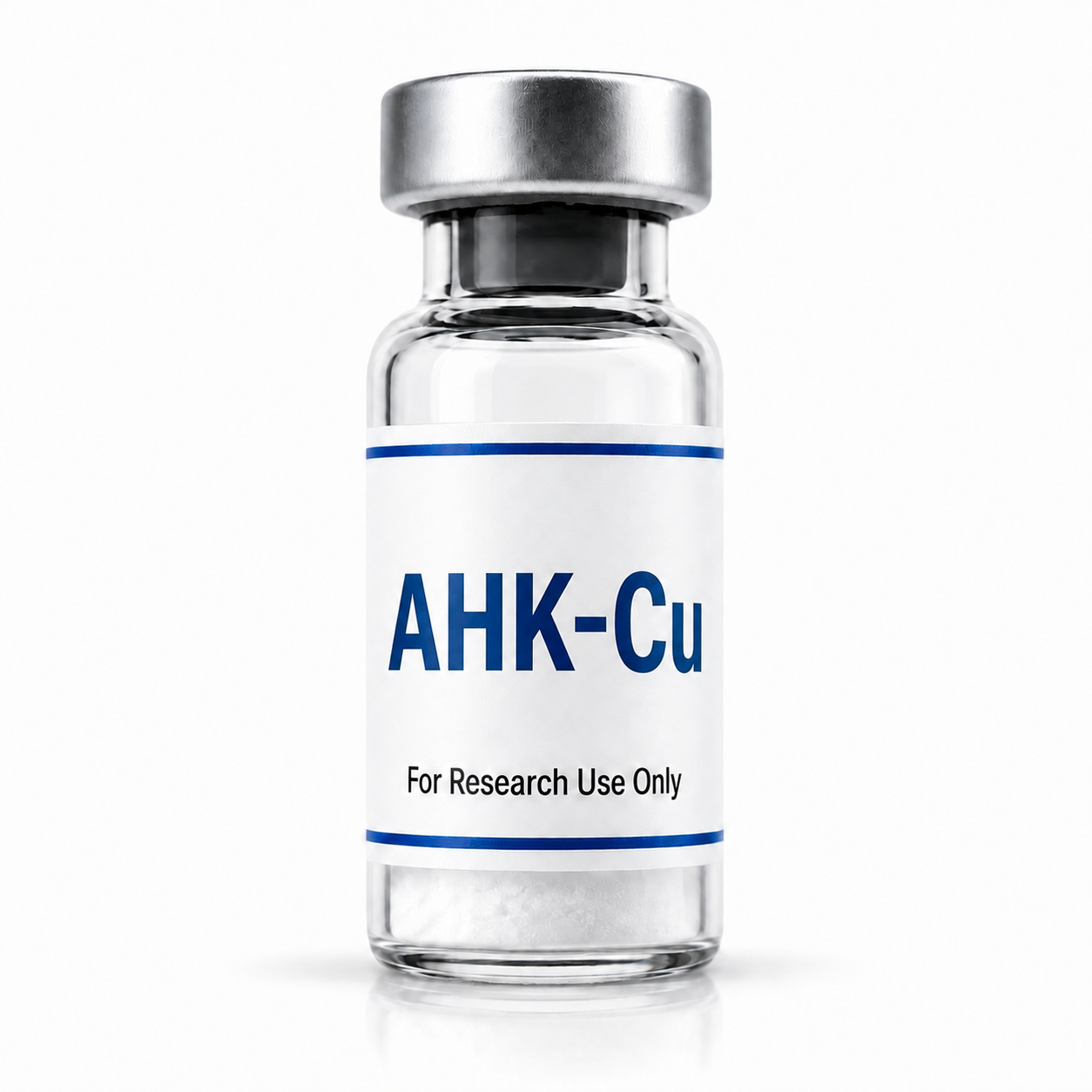
The blue colour as an identity check Copper(II) complexes of this peptide class are blue. A white or off-white powder sold as AHK-Cu is the uncomplexed free peptide, not the copper complex. This is the fastest visual discriminator available and it costs nothing to state.
Relationship to GHK-Cu
AHK-Cu is GHK-Cu with one methyl group added. That is the entire structural difference, and it is worth laying out precisely because the two are constantly conflated — including in supplier synonym lists, where "AHK-Cu" appears as an alias on GHK-Cu catalogue entries.
Sequence Gly-His-Lys Ala-His-Lys Free peptide formula C14H24N6O4 C15H26N6O4 Free peptide MW 340.38 g/mol 354.40 g/mol Free peptide CAS 49557-75-7 126828-32-8 Complex formula C14H22CuN6O4 C15H24CuN6O4 Complex CAS 89030-95-5 682809-81-0 INCI name Copper Tripeptide-1 Copper Tripeptide-3 Origin naturally occurring synthetic (isolated from human plasma) Research emphasis wound healing, dermal hair follicle and matrix, collagen dermal papilla
Glycine has no side chain; alanine has a methyl group. Substituting one for the other at position 1 adds CH2 — 14.02 Da — which is exactly the difference between 340.38 and 354.40 and between the two formulas.
The consequential difference is provenance, not mass. GHK-Cu is a naturally occurring peptide first isolated from human plasma, with decades of wound-healing literature behind it. AHK-Cu is a synthetic analogue whose literature is smaller and concentrated on hair.
Distinct INCI names — Copper Tripeptide-1 versus Copper Tripeptide-3 — mean they are separately registered cosmetic ingredients, not interchangeable listings.
Mechanism and research
The AHK-Cu literature is narrower than GHK-Cu's and centres on the hair follicle. Four reported actions recur.
Dermal papilla cell proliferation
Dermal papilla cells are the mesenchymal population that regulates follicle cycling. AHK-Cu is reported to increase their proliferation — the mechanistic basis for the hair-directed interest.
VEGF upregulation
Reported elevation of vascular endothelial growth factor, the angiogenic signal supporting perifollicular vasculature and therefore nutrient delivery to the follicle.
TGF-β1 reduction
Reported reduction in TGF-β1 secretion. This is the mechanistically interesting one: TGF-β1 is implicated in the catagen transition and in DHT-driven follicle miniaturization, so reducing it is framed as opposing that pathway rather than stimulating growth directly.
Follicle elongation ex vivo
Reported stimulation of human hair follicle elongation in ex vivo culture at concentrations as low as 10⁻¹² M, with prolongation of anagen.
Copper-dependent enzymology
As a copper carrier, AHK-Cu is studied for delivery of Cu(II) to copper-dependent enzymes. Two are named repeatedly:
Lysyl oxidase catalyses collagen and elastin crosslinking; the link to matrix integrity Superoxide dismutase copper-zinc SOD; the link to oxidative stress handling
The copper is not incidental packaging. Chelation is described as distinguishing the complex from the uncomplexed peptide, both for cofactor delivery and for conferring oxidative resistance on the peptide itself.
Dermal and matrix research
Reported effects on fibroblast activity, collagen synthesis and glycosaminoglycan production, with TGF-β pathway involvement — the overlap zone with the much larger GHK-Cu literature, where AHK-Cu typically appears as a comparator rather than the primary subject.
Comparative use
AHK-Cu is most often run alongside GHK-Cu in protocols examining how sequence and metal-binding affinity differences affect downstream signalling. Reports that GHK binds copper more tightly while AHK shows more pronounced hair effects are the usual framing, though the direct head-to-head evidence base is thin.
Regulatory status
AHK-Cu is a registered cosmetic ingredient under the INCI designation Copper Tripeptide-3. INCI listing is ingredient nomenclature, not a safety or efficacy approval.
It is not approved by the FDA as a drug for any indication. There are no controlled human clinical trials establishing efficacy for hair growth; the evidence base is in vitro, ex vivo and preclinical.
Material supplied for laboratory use is a research chemical. It is not a drug, food, cosmetic, or dietary supplement as supplied, has not been evaluated by the FDA, and is not intended for human or veterinary use.
Specifications
| Attribute | Value |
|---|---|
| Sequence | Ala-His-Lys |
| Written | H-Ala-His-Lys-OH |
| Molecular formula | C15H26N6O4 |
| Molecular weight | 354.40 g/mol |
| CAS Number (free peptide) | 126828-32-8 |
| CAS Number (Cu complex) | 682809-81-0 |
| PubChem CID | 7408502 ↗ |
| MDL Number | MFCD13906333 |
| Appearance | white to off-white powder |
| INCI name | Copper Tripeptide-3 |
| Copper complex formula | C15H24CuN6O4 |
| Solubility | water and polar solvents; reconstitutes in |
| Handling | avoid repeated freeze-thaw; keep sealed |