Research compound · Checked
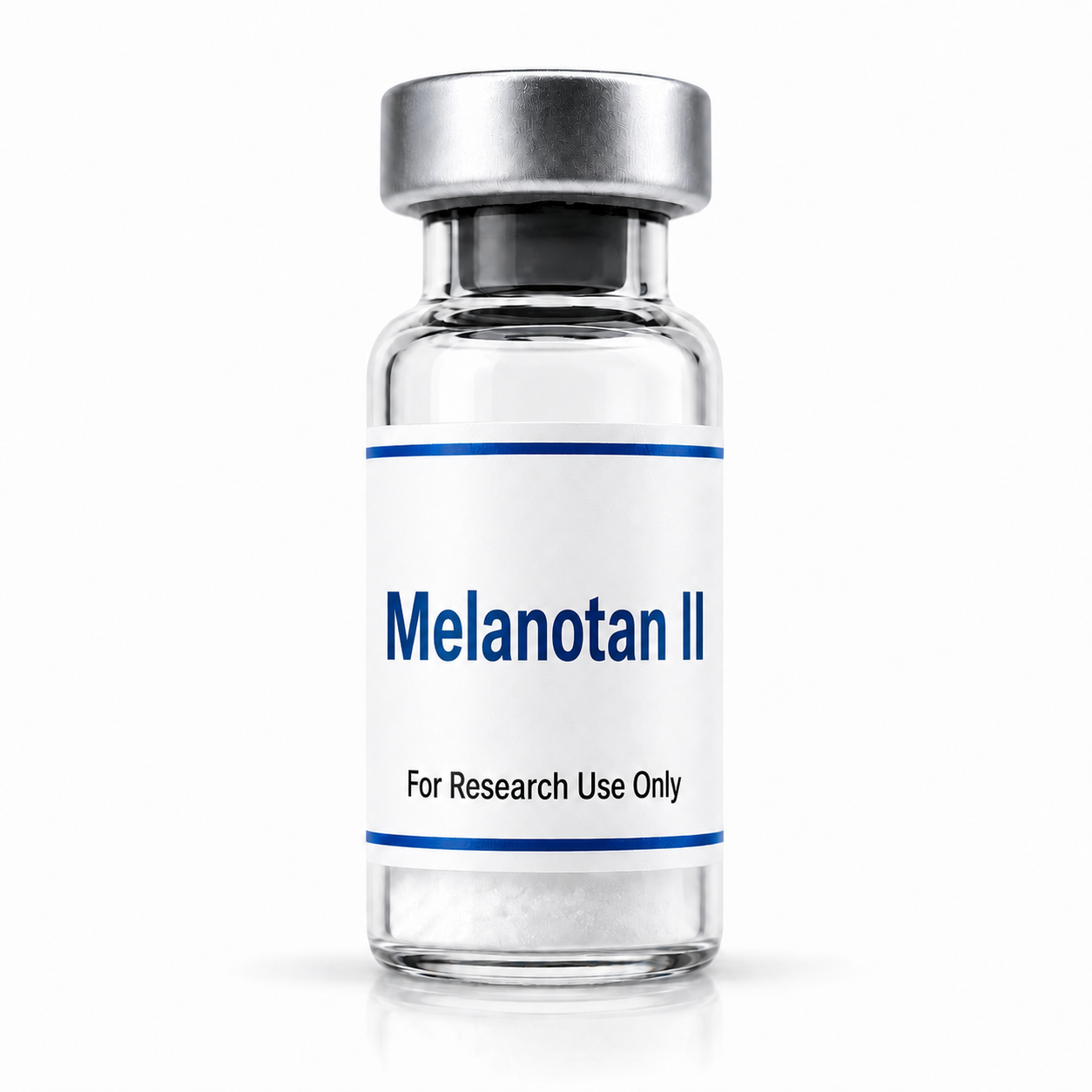
Melanotan II
Every price, divided down to the milligram.
Sticker prices hide what a compound actually costs, because vial sizes differ. So we divide the listing by its stated peptide content and show the real cost per milligram.
Vendors pay us a commission when you buy through our links. It never changes the order — rows are sorted by measured price per mg, and every flag is computed from the data shown. Read the full disclosure
Where to buy
One listing trackedHow this page is funded: vendors listed here pay us a commission when you buy through our links. Commissions never change the ranking — rows are ordered by measured price per mg, and flags are computed from the data on this page. Sponsored placements, if any, are always labeled.
On this page
How to read these rows
Verify the COA
A certificate of analysis should come from an independent lab, reference the exact batch number on the label, and be recent. Vendor-issued documents without a named third-party lab carry less weight — the COA row links to what each vendor publishes.
Match the format
Lyophilized vials and sprays are different products with different concentrations. That is why sprays sit outside the $/mg ranking — compare vials to vials, sprays to sprays.
Count the total cost
Shipping fees, free-shipping thresholds and active discount codes can flip which vendor is actually cheapest for your order size. The $/mg figure is the baseline; the shipping and code details finish the math.
How we rank
The row below carries a price per mg figure: listed price divided by stated peptide content, excluding shipping and codes. It is the same calculation applied on every compound page, so a figure here is directly comparable to one anywhere else on the site.
We currently track a single listing for this compound. When a second vendor is added the rows are ordered by measured $/mg, and the flags for testing and shipping are computed from the data shown. Each row carries its own verification date.
Cyclic lactam alpha-MSH heptapeptide analog
A 7-residue macrocyclic peptide retaining the His-Phe-Arg-Trp recognition motif of native alpha-MSH, closed by a side-chain lactam bridge between aspartate and lysine. Characterized in the primary literature as a non-selective melanocortin receptor agonist. For laboratory characterisation only.
Melanotan II — mechanistic profile
Melanotan II is a synthetic cyclic heptapeptide analog of alpha-MSH, designed at the University of Arizona in the early 1990s. A side-chain lactam bridge closes the macrocycle and confers resistance to enzymatic degradation relative to the linear parent peptide. It is characterized in the published in-vitro literature as a non-selective agonist across MC1R, MC3R, MC4R and MC5R, with minimal activity at MC2R. No compound containing Melanotan II has been approved by any regulatory agency.
Studied applications
- Melanogenesis pathways
- examined in dermal models for eumelanin
- Melanocortin receptor pharmacology
- used as a broad-spectrum probe
- Energy homeostasis
- MC4R-mediated feeding behavior in murine models
- Structure-activity research
- reference compound for conformationally
- cAMP signaling
- downstream second-messenger characterization in
Research constraints & safety notes
- Not approved for any indication by FDA, EMA, MHRA, TGA, or Health
- Not eligible for pharmaceutical compounding under FD&C 503A or 503B
- No completed or published Phase 3 safety or efficacy trial exists
- Human data limited to small studies from the 1990s and 2000s;
- Receptor non-selectivity means observed effects are not confined to a
- Published case literature in dermatology and emergency medicine
- Regulatory agencies in the US, UK and Australia have issued public
MC1R
Melanocortin-1 receptor Ki ≈ 1.4 nM Full agonist (in vitro)
Competitive binding assays in human MC1R-overexpressing HEK293 cells using radiolabeled NDP-alpha-MSH report low-nanomolar affinity. MC1R is expressed on melanocytes and regulates eumelanin versus phaeomelanin synthesis.
MC3R
Melanocortin-3 receptor High affinity Full agonist (in vitro)
Reported in the primary literature as a full agonist at MC3-R. The receptor is implicated in energy homeostasis and is expressed on immune cell populations.
MC4R
Melanocortin-4 receptor High affinity Full agonist (in vitro)
Full agonist activity reported at MC4-R. Intracerebroventricular administration inhibited feeding across four murine models of hyperphagia, a finding central to the subsequent MC4R energy-balance literature.
MC5R
Melanocortin-5 receptor High affinity Full agonist (in vitro)
Engagement reported in cAMP accumulation assays. MC5R is expressed in peripheral tissues and associated with exocrine and sebaceous secretion.
MC2R
Melanocortin-2 receptor (ACTH receptor) Ki > 1 μM Minimal activity (in vitro)
The pharmacologically notable exclusion. Reported affinity above 1 micromolar separates Melanotan II activity from the adrenocorticotropic / corticosteroid axis.
Binding and functional values are from in-vitro assays reported in peer-reviewed literature. In-vitro characterisation only — no clinical or therapeutic claim is expressed or implied. Research use only.
Structure-activity design
In-vitro receptor binding · cyclic analog series Hruby et al., J Med Chem 1995
Feeding-behavior model
Murine hyperphagia models · intracerebroventricular administration Fan et al., Nature 1997
Melanogenesis RCT
Randomized controlled trial · fair-skinned subjects Barnetson et al., Br J Dermatol 2006
Erectile response crossover
Double-blind, placebo-controlled crossover · psychogenic ED Wessells et al., Urology 1998
Phase-I pilot
Dose-escalation tolerability pilot Dorr et al., Life Sci 1996
Reference chemistry and regulatory status only. Literature on one of these compounds does not transfer to the others; citations should be checked against the compound actually studied.
What Melanotan II is
Melanotan II is a synthetic cyclic heptapeptide analog of alpha-melanocyte-stimulating hormone (alpha-MSH). It has molecular formula C50H69N15O9 and mass 1024.2 g/mol, with published sequence Ac-Nle-c[Asp-His-D-Phe-Arg-Trp-Lys]-NH2. Three modifications distinguish it from the corresponding alpha-MSH fragment: norleucine at position 4 in place of an oxidation-sensitive methionine, D-phenylalanine at position 7, and a side-chain lactam bridge between aspartate and lysine that closes the macrocycle. Common synonyms in the literature include MT-II, MT-2, and Ac-[Nle4, Asp5, D-Phe7, Lys10]-alpha-MSH (4-10)-NH2.
Note on structure: the ring is a lactam (amide) bridge, not a disulfide. The sequence contains no cysteine residues. Several secondary sources describe the cyclization incorrectly.
What it's studied for
Investigation of Melanotan II is limited in scale, concentrated in the 1990s and 2000s, and comprises in-vitro receptor pharmacology, animal models, and small early-phase human studies rather than large randomized trials. Published work spans structure-activity research, establishing the cyclization strategy and its receptor-binding consequences; melanogenesis research, including a randomized controlled trial examining eumelanin synthesis in fair-skinned subjects and a phase-I pilot characterizing tolerability; feeding-behavior research, in which intracerebroventricular administration was reported to inhibit feeding across four murine models of hyperphagia; and erectile-response research in a double-blind placebo-controlled crossover design. Nausea and flushing are reported as dose-limiting across the human studies. None of this material establishes therapeutic outcomes in humans, and no Phase 3 trial has been completed or published.
Laboratory handling — storage and reconstitution
Melanotan II is supplied as a lyophilized powder, soluble in water and saline. Reconstitution is typically performed with bacteriostatic water per laboratory SOP. Protect from light and moisture, and minimize freeze-thaw cycles by aliquoting for extended storage. Vendor storage guidance for this compound is not consistent — published recommendations range from 2–8 °C to −20 °C for lyophilized material. Because the compound has no approved formulation, no official monograph exists; follow the guidance supplied with your specific lot alongside your own laboratory protocol.
Regulatory status
Melanotan II is not approved for any indication by the FDA, EMA, MHRA, TGA, or Health Canada, and has never been submitted for regulatory review in any jurisdiction. It is not eligible for pharmaceutical compounding under sections 503A or 503B of the Federal Food, Drug, and Cosmetic Act. Regulatory agencies in the United States, United Kingdom and Australia have issued public warnings regarding this compound, and published case reports in the dermatology and emergency medicine literature describe serious adverse events associated with non-research use.
For research use only. This summary is compiled from peer-reviewed sources. It is not medical advice and is not intended for human or veterinary consumption.
Specifications
| Attribute | Value |
|---|---|
| Molecular Formula | C50H69N15O9 |
| Molecular Weight | 1024.2 g/mol |
| Sequence | Ac-Nle-c[Asp-His-D-Phe-Arg-Trp-Lys]-NH2 |
| IUPAC Condensed | Ac-Nle-Asp(1)-His-D-Phe-Arg-Trp-Lys(1)-NH2 |
| CAS Number | 121062-08-6 |
| Structure | Cyclic lactam heptapeptide |
| Cyclization | Side-chain lactam, Asp2 to Lys7 |
| Appearance | White lyophilized powder |
| Solubility | Water, saline |
| Sequence length | 7 residues (cyclic) |
| Physical form | Lyophilized powder |
| PubChem CID | 92432 ↗ |
Chemistry and regulatory comparison — melanocortin analogs
Three structurally distinct melanocortin analogs frequently conflated in secondary sources. Reference chemistry and regulatory status only — no comparative-effectiveness claim expressed or implied.
| Compound | Structure | Receptor profile | Regulatory status | Approved indication |
|---|---|---|---|---|
| Melanotan I (afamelanotide) Linear 13-residue MC1R-selective FDA approved Oct 2019; EMA approved Phototoxicity in erythropoietic protoporphyriaMelanotan II | Cyclic 7-residue lactam | Non-selective MC1R/3R/4R/5R | Never submitted for review in any jurisdiction | None |