Secretagogue Peptide · Checked
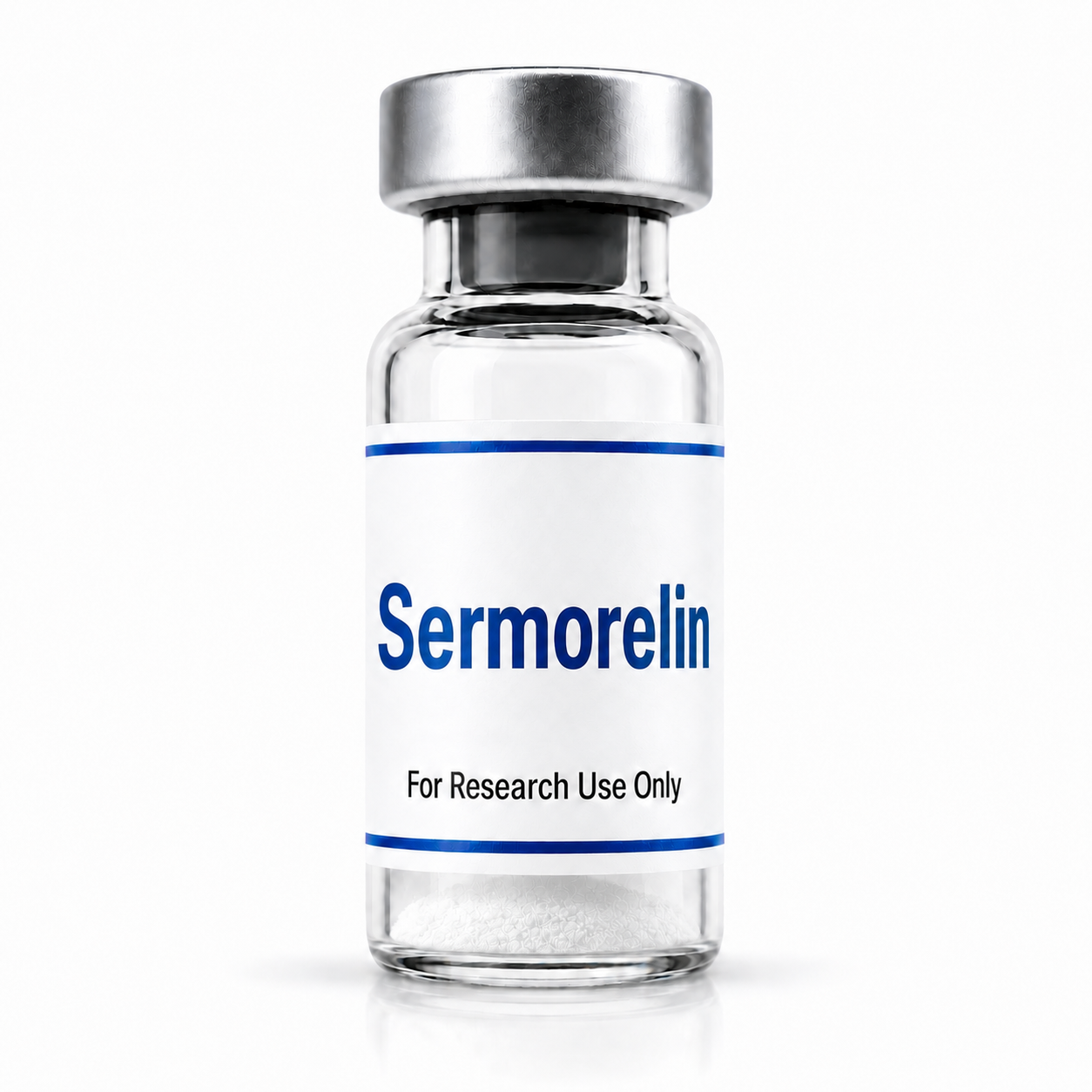
Sermorelin
Every price, divided down to the milligram.
Sticker prices hide what a compound actually costs, because vial sizes differ. So we divide the listing by its stated peptide content and show the real cost per milligram.
Vendors pay us a commission when you buy through our links. It never changes the order — rows are sorted by measured price per mg, and every flag is computed from the data shown. Read the full disclosure
Where to buy
One listing trackedHow this page is funded: vendors listed here pay us a commission when you buy through our links. Commissions never change the ranking — rows are ordered by measured price per mg, and flags are computed from the data on this page. Sponsored placements, if any, are always labeled.
On this page
How to read these rows
Verify the COA
A certificate of analysis should come from an independent lab, reference the exact batch number on the label, and be recent. Vendor-issued documents without a named third-party lab carry less weight — the COA row links to what each vendor publishes.
Match the format
Lyophilized vials and sprays are different products with different concentrations. That is why sprays sit outside the $/mg ranking — compare vials to vials, sprays to sprays.
Count the total cost
Shipping fees, free-shipping thresholds and active discount codes can flip which vendor is actually cheapest for your order size. The $/mg figure is the baseline; the shipping and code details finish the math.
How we rank
The row below carries a price per mg figure: listed price divided by stated peptide content, excluding shipping and codes. It is the same calculation applied on every compound page, so a figure here is directly comparable to one anywhere else on the site.
We currently track a single listing for this compound. When a second vendor is added the rows are ordered by measured $/mg, and the flags for testing and shipping are computed from the data shown. Each row carries its own verification date.
About Sermorelin
Sequence
H-Tyr-Ala-Asp-Ala-Ile-Phe-Thr-Asn-Ser-Tyr-Arg-Lys-Val-Leu-Gly- Gln-Leu-Ser-Ala-Arg-Lys-Leu-Leu-Gln-Asp-Ile-Met-Ser-Arg-NH2
One-letter (backbone)
YADAIFTNSYRKVLGQLSARKLLQDIMSR
Designations
Sermorelin (INN) · GRF (1-29) · GHRH (1-29) · GRF 1-29 amide · Geref (former trade name)
Storage and handling
- Appearance
- white lyophilized powder
- Solubility
- aqueous laboratory buffers
- Storage, lyophilized
- −20 °C
- Storage, reconstituted
- 2–8 °C, use promptly, avoid repeated freeze-thaw
Elimination half-life
Reported at approximately 11–12 minutes, with the broader literature giving a range of roughly 10–20 minutes. The short half-life reflects rapid peptidase cleavage of the unmodified sequence and is the defining pharmacokinetic feature of the compound.
Position within the GHRH family
Native human GHRH is a 44-residue peptide. Sermorelin is its first 29 residues, amidated at the C-terminus — and is described in the literature as the shortest fragment that retains full GHRH receptor activity. Everything else in this compound class is a modification of that same scaffold.
Native hGHRH (1-44)
YADAIFTNSYRKVLGQLSARKLLQDIMSRQQGESNQERGARARL
Sermorelin — hGHRH (1-29)-NH2
YADAIFTNSYRKVLGQLSARKLLQDIMSR-NH2 The N-terminal 29 residues, amidated. No further modification.
Half-life approximately 11-12 minutes.
Tesamorelin — [trans-3-hexenoyl]hGHRH(1-44)-NH2
The full 44-residue sequence with a C6 hexenoyl group carrying a double bond at position 3, attached to the N-terminal tyrosine.
Reported elimination half-life 8 minutes.
CJC-1295 / modified GRF (1-29)
The 29-residue scaffold carrying amino acid substitutions selected for resistance to enzymatic degradation, extending duration relative to unmodified sermorelin.
Sermorelin is therefore the unmodified reference member of the family: the native fragment against which the stabilized analogs are compared. Its first 29 residues are identical to the first 29 of tesamorelin's backbone.
Receptor
Sermorelin binds the growth hormone-releasing hormone receptor (GHRHR), a G protein-coupled receptor expressed on somatotroph cells of the anterior pituitary.
Signalling cascade, as described in the literature Receptor engagement activates adenylyl cyclase, converting ATP to cyclic AMP. Rising cAMP activates protein kinase A, which phosphorylates a number of targets including voltage-dependent calcium channels in the cell membrane. Opening of those channels permits calcium influx; the resulting rise in intracellular calcium drives secretory vesicles within the somatotroph to release stored growth hormone.
Secretagogue rather than replacement
The distinction that defines the compound class. Sermorelin does not supply exogenous growth hormone. It signals the pituitary to release the endogenous hormone, which means output remains subject to normal physiological feedback — including negative feedback from somatostatin and from IGF-1. Exogenous GH administration bypasses that regulation entirely.
Receptor specificity
The literature reports that sermorelin's action is relatively specific to GHRHR, without significant alteration of prolactin, insulin, cortisol, glucose, or thyroid hormone levels.
Downstream
Increased GH secretion raises insulin-like growth factor-1 (IGF-1), which mediates much of the anabolic activity attributed to growth hormone.
Tachyphylaxis
Some sources report that sermorelin does not appear subject to tachyphylaxis, and suggest upregulation rather than downregulation of GHRH receptors with repeated exposure. This is a claim from the secondary literature rather than a settled finding.
Pediatric growth hormone deficiency
The original clinical application. Sermorelin was reviewed for use in the diagnosis and treatment of children with idiopathic growth hormone deficiency, with subcutaneous administration at 30 µg/kg reported to increase growth velocity.
(Prakash & Goa, BioDrugs, 1999)
Pulsatile administration
Early work established that pulsatile infusion of an amidated GHRH fragment produced growth in normal and GHRH-deficient rats.
(Clark & Robinson, Nature, 1985)
Older adults — GH and IGF-1
Single nightly injections of GHRH(1-29) were examined in healthy elderly men.
(Vittone et al., Metabolism, 1997)
A 16-week study in age-advanced men and women reported increases in growth hormone release, IGF-1, lean body mass and skin thickness.
Note that this study used [Nle27]GHRH(1-29)-NH2 — a norleucine- substituted analog at position 27, not sermorelin itself, which carries methionine at that position.
(Khorram, Laughlin & Yen, JCEM, 1997)
Cardiac remodelling
GHRH agonists have been examined in models of myocardial infarction, with reported reductions in infarct scar in swine with subacute ischemic cardiomyopathy and effects on fibrosis, apoptosis and cardiac repair pathways.
(Bagno et al., JAHA, 2015; Kanashiro-Takeuchi et al., Oncotarget, 2015)
Epilepsy
Interactions between GHRH and GABA-A receptors have been examined in animal models of epilepsy and in tissue from patients with epilepsy.
(Tang et al., Scientific Reports, 2017)
Sleep
Growth hormone secretion peaks during slow-wave sleep, and the relationship between the GHRH axis and sleep architecture has been examined in both animal and human work, including orexin signalling.
(Shepherd et al., Comp Biochem Physiol, 2007; Zaffanello et al., Frontiers in Endocrinology, 2024)
Visceral fat and metabolic indices
Effects of GHRH on visceral fat and cardiovascular indices have been reviewed across human studies.
(Stanley & Grinspoon, Growth Hormone IGF Research, 2014)
Combination with ghrelin mimetics
Growth hormone secretagogues such as GHRP-6 and GHRP-2 act at the ghrelin receptor (GHS-R) rather than GHRHR. Because the two classes engage separate receptors, combined administration has been examined for additive effect, with reported IGF-1 elevations exceeding those from either class alone.
(Sigalos et al., American Journal of Men's Health, 2017)
Body composition in hypogonadal males
Reviewed in the context of growth hormone secretagogues and body composition management.
(Sinha et al., Translational Andrology and Urology, 2020)
Regulatory status
Sermorelin acetate was formerly marketed in the United States as Geref for pediatric growth hormone deficiency. It is no longer available as a marketed product in the US.
Sermorelin appears on the World Anti-Doping Agency prohibited list. Growth hormone releasing factors are prohibited at all times under the WADA Code, which is relevant to any research context involving competitive athletes.
Material supplied for laboratory use is a research chemical. It is not a drug, food, cosmetic, or dietary supplement as supplied, has not been evaluated by the FDA in that form, and is not intended for human or veterinary use.
Specifications
| Attribute | Value |
|---|---|
| Molecular formula | C149H246N44O42S |
| Molecular weight | 3357.93 g/mol |
| CAS Number | 86168-78-7 |
| PubChem CID | 16129620 ↗ |
| DrugBank | DB00010 |
| Residue count | 29, C-terminally amidated |
| Structure class | linear peptide, free N-terminus, |
| Origin | N-terminal residues 1-29 of human growth |