Peptide Secretagogue Analogs · Checked
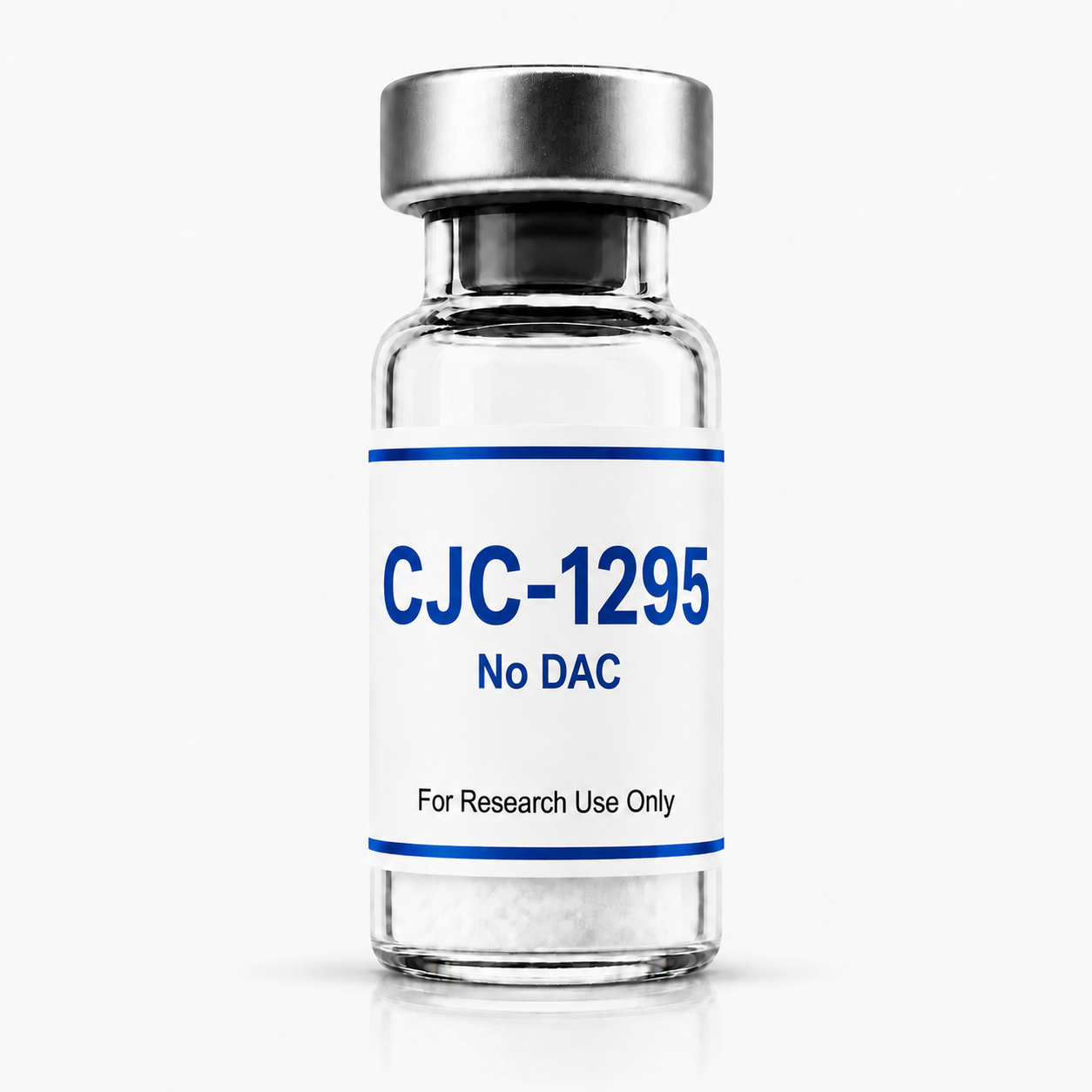
CJC-1295 No DAC
Every price, divided down to the milligram.
Sticker prices hide what a compound actually costs, because vial sizes differ. So we divide the listing by its stated peptide content and show the real cost per milligram.
Vendors pay us a commission when you buy through our links. It never changes the order — rows are sorted by measured price per mg, and every flag is computed from the data shown. Read the full disclosure
Where to buy
One listing trackedHow this page is funded: vendors listed here pay us a commission when you buy through our links. Commissions never change the ranking — rows are ordered by measured price per mg, and flags are computed from the data on this page. Sponsored placements, if any, are always labeled.
On this page
How to read these rows
Verify the COA
A certificate of analysis should come from an independent lab, reference the exact batch number on the label, and be recent. Vendor-issued documents without a named third-party lab carry less weight — the COA row links to what each vendor publishes.
Match the format
Lyophilized vials and sprays are different products with different concentrations. That is why sprays sit outside the $/mg ranking — compare vials to vials, sprays to sprays.
Count the total cost
Shipping fees, free-shipping thresholds and active discount codes can flip which vendor is actually cheapest for your order size. The $/mg figure is the baseline; the shipping and code details finish the math.
How we rank
The row below carries a price per mg figure: listed price divided by stated peptide content, excluding shipping and codes. It is the same calculation applied on every compound page, so a figure here is directly comparable to one anywhere else on the site.
We currently track a single listing for this compound. When a second vendor is added the rows are ordered by measured $/mg, and the flags for testing and shipping are computed from the data shown. Each row carries its own verification date.
Long-acting GHRH-receptor analog (no-DAC variant)
GHRH analog (Modified GRF 1-29) that stimulates natural, pulsatile growth-hormone release.
A 29-residue growth-hormone-releasing hormone analog (also known as tetrasubstituted GRF 1-29 / mod-GRF 1-29) characterised in the primary literature as a GHRH-receptor agonist with amino-acid substitutions at positions 2, 8, 15, and 27 that reduce enzymatic cleavage. For laboratory characterisation only.
Research summary
CJC-1295 without DAC (Mod GRF 1-29) — clinical & mechanistic profile
Mod GRF 1-29 is a tetrasubstituted GHRH analog (Ala2, Gln8, Ala15, Leu27) with ~30-minute half-life (vs ~7 min native GHRH) due to DPP-IV resistance. Lacking DAC's albumin binding, it produces acute pulsatile GH release mimicking physiology, synergizing with GHRPs via complementary cAMP/Ca2+ pathways.
Studied applications
- Preserved pulsatility
- ~30 min half-life produces discrete GH spikes mimicking physiological patterns
- DPP-IV resistance
- Ala2 substitution blocks primary degradation enzyme, extending duration from ~7 to ~30 min
- GHRP synergy
- cAMP pathway (GHRH) + Ca2+/IP3 pathway (GHRPs) produce amplified GH pulses beyond additive effects
- Flexible protocols
- short duration allows timing with natural GH windows (sleep, exercise)
- No albumin binding
- lacks DAC moiety, enabling rapid clearance and pulsatile administration
Research constraints & safety notes
- Not approved for human therapeutic use
- Short half-life requires 2-3 daily injections for meaningful effects
- No completed human clinical trials for this specific compound
- Quality and purity of research compounds varies
- Optimal dosing and timing protocols not established
Full agonist (in vitro)
In-vitro cAMP assays in HEK-GHRHR cells report full agonism at the GHRH receptor. The 4 amino-acid substitutions vs native GHRH(1-29) are described as reducing DPP-IV degradation and extending in-vitro stability.
In-vitro / preclinical characterisation only — no clinical or therapeutic claim is expressed or implied. Research use only.
Product Description
What CJC-1295 without DAC (Mod GRF 1-29) is
CJC-1295 without DAC (Mod GRF 1-29) is a synthetic 29-amino acid GHRH analog (tetrasubstituted). Mod GRF 1-29 is a tetrasubstituted GHRH analog (Ala2, Gln8, Ala15, Leu27) with ~30-minute half-life (vs ~7 min native GHRH) due to DPP-IV resistance. Lacking DAC's albumin binding, it produces acute pulsatile GH release mimicking physiology, synergizing with GHRPs via complementary cAMP/Ca2+ pathways. It has a molecular formula C152H252N44O42, mass 3367.95 Da. Common synonyms in the literature include Mod GRF 1-29, Modified GRF, and CJC-1295 no DAC.
What it’s studied for
Investigation of CJC-1295 without DAC (Mod GRF 1-29) to date is primarily preclinical, with the majority of citations concentrated in animal models and in-vitro assays rather than randomized controlled human trials. Published work referencing CJC-1295 without DAC (Mod GRF 1-29) spans Structure-activity research: Studies established that Ala2 substitution prevents cleavage by dipeptidyl peptidase IV (DPP-IV), the primary GHRH-degrading enzyme. The other substitutions (Gln8, Ala15, Leu27) further enhance stability without compromising receptor binding, Combination research: Preclinical and anecdotal studies suggest GHRH + GHRP combinations produce synergistic GH release. The distinct signaling pathways (cAMP vs. calcium) converge on somatotrophs to amplify secretion beyond additive effects, and Pulsatility preservation: Unlike CJC-1295 DAC, the short half-life of Mod GRF 1-29 allows discrete GH pulses when administered 2-3 times daily. This mimics normal physiological secretion patterns more closely than sustained-release compounds. Proposed mechanisms in the literature include GHRHR full agonism: binds pituitary GHRH receptor, triggering Gs-protein coupling and adenylyl cyclase and cAMP/PKA pathway: adenylyl cyclase → cAMP → PKA activation → GH gene transcription and vesicle release. None of this material describes therapeutic outcomes in humans, and No vendor listed here provides dosing guidance for CJC-1295 without DAC (Mod GRF 1-29) outside laboratory research.
Related research
For the full mechanistic profile, published references, and constraint notes on CJC-1295 without DAC (Mod GRF 1-29), see the CJC-1295 without DAC (Mod GRF 1-29) research page. All references cited on that page are peer-reviewed primary literature.
For research use only. This summary is a research-scientific overview compiled from peer-reviewed sources. It is not medical advice and is not intended for human or veterinary consumption.
Receptor engagement in the primary literature
Binding and functional-assay data for CJC-1295 No DAC, from peer-reviewed in-vitro pharmacology publications. Values are receptor activity parameters — not clinical outcomes.
Investigational context
Study designs referencing this compound in the published literature. Descriptions cover framework only — phase, participant count, duration, and citation — not outcomes. Click a card to review the source directly.
Specifications
| Attribute | Value |
|---|---|
| Molecular Formula | C152H252N44O42 |
| CAS Number | 863288-34-0 |
| InChIKey | XOZMWINMZMMOBR-UHFFFAOYSA-N |
| Molecular Weight | 3367.97 g/mol |
| Sequence | Tyr-D-Ala-Asp-Ala-Ile-Phe-Thr-Gln-Ser-Tyr-Arg-Lys-Val-Leu-Ala-Gln-Leu-Ser-Ala-Arg-Lys-Leu-Leu-Gln-Asp-Ile-Leu-Ser-Arg-NH2 |
| Sequence length | 29 residues |
| Physical form | Lyophilized powder |
| PubChem CID | 91976842 ↗ |
Chemistry comparison — growth-hormone secretagogue peptides
Two peptide research compounds published as growth-hormone-secretagogue-family molecules with distinct receptor targets. Reference chemistry only.
| Compound | Sequence | MW | Half-life (lit.) | Reference |
|---|---|---|---|---|
| Ipamorelinpeptide | 5 residues | 711.85 g/mol | ~2 hours (lit.) | Raun Eur J Endocrinol 1998 |
| CJC-1295 (no-DAC)peptide | 29 residues | 3367.9 g/mol | ~30 min (lit.) | Alba JCEM 2006 |
Reference chemistry only. Receptor-binding indications are qualitative (compound engages / does not engage the receptor in in-vitro assays as reported in the cited literature). No comparative-effectiveness claim is expressed or implied.