Bioregulator Compounds · Checked
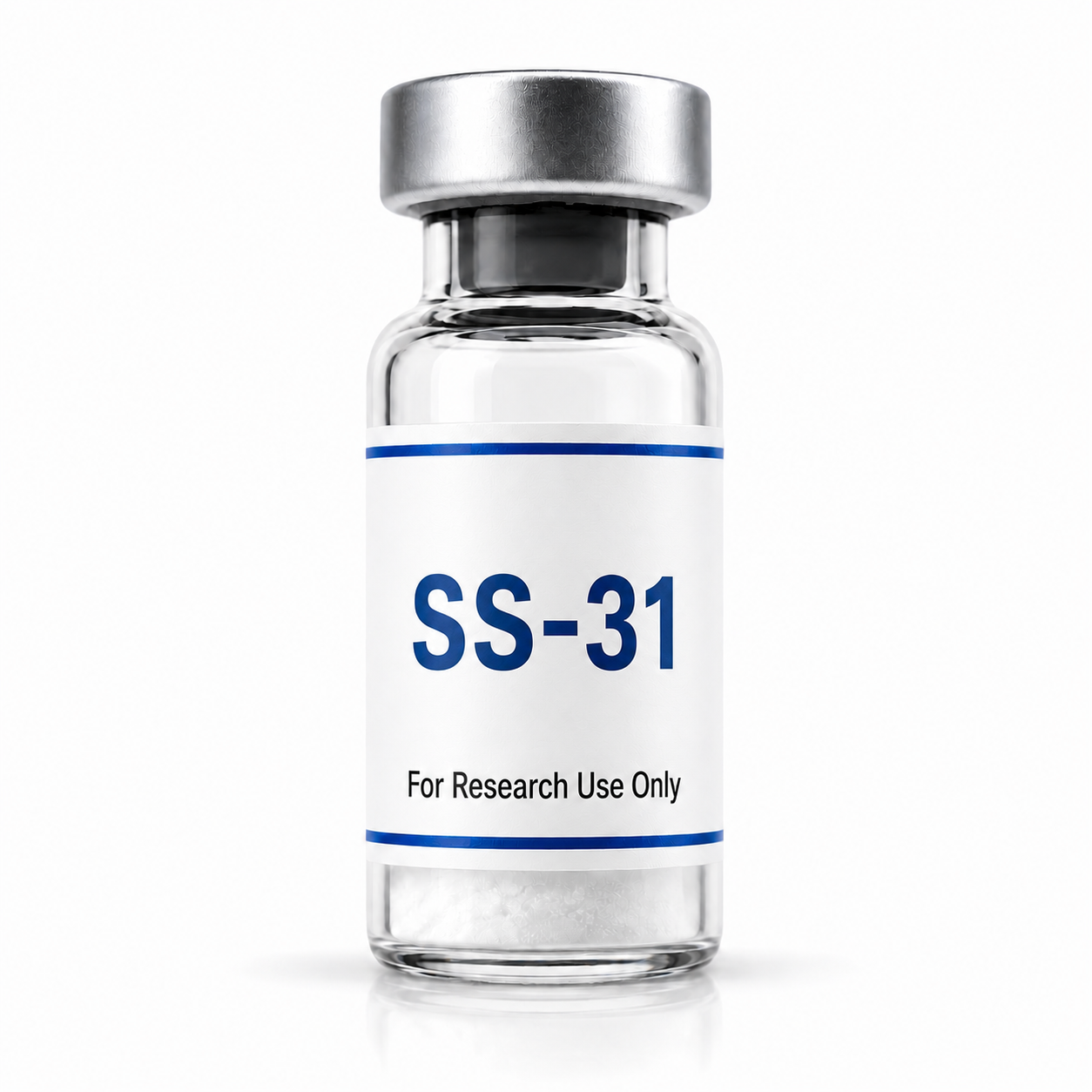
SS-31 (Elamipretide)
Every price, divided down to the milligram.
Sticker prices hide what a compound actually costs, because vial sizes differ. So we divide the listing by its stated peptide content and show the real cost per milligram.
Vendors pay us a commission when you buy through our links. It never changes the order — rows are sorted by measured price per mg, and every flag is computed from the data shown. Read the full disclosure
Where to buy
One listing trackedHow this page is funded: vendors listed here pay us a commission when you buy through our links. Commissions never change the ranking — rows are ordered by measured price per mg, and flags are computed from the data on this page. Sponsored placements, if any, are always labeled.
On this page
How to read these rows
Verify the COA
A certificate of analysis should come from an independent lab, reference the exact batch number on the label, and be recent. Vendor-issued documents without a named third-party lab carry less weight — the COA row links to what each vendor publishes.
Match the format
Lyophilized vials and sprays are different products with different concentrations. That is why sprays sit outside the $/mg ranking — compare vials to vials, sprays to sprays.
Count the total cost
Shipping fees, free-shipping thresholds and active discount codes can flip which vendor is actually cheapest for your order size. The $/mg figure is the baseline; the shipping and code details finish the math.
How we rank
The row below carries a price per mg figure: listed price divided by stated peptide content, excluding shipping and codes. It is the same calculation applied on every compound page, so a figure here is directly comparable to one anywhere else on the site.
We currently track a single listing for this compound. When a second vendor is added the rows are ordered by measured $/mg, and the flags for testing and shipping are computed from the data shown. Each row carries its own verification date.
Cardiolipin-binding mitochondrial-targeted tetrapeptide
Mitochondria-targeting tetrapeptide (D-Arg-Dmt-Lys-Phe-NH₂) that binds cardiolipin on the inner mitochondrial membrane. FDA-approved as FORZINITY for Barth syndrome. Studied for cardioprotection, aging muscle, and neurodegenerative disease research.
A synthetic 4-residue peptide (D-Arg-Dmt-Lys-Phe-NH₂) engineered to concentrate more than a thousand-fold at the inner mitochondrial membrane, where it binds cardiolipin in in-vitro assays. FDA-approved as FORZINITY (2025) for Barth syndrome. For laboratory characterisation only.
SS-31 (Elamipretide) — clinical & mechanistic profile
SS-31 (elamipretide) is a mitochondria-targeting tetrapeptide that binds cardiolipin on the inner mitochondrial membrane. FDA-approved for Barth syndrome (FORZINITY). 2025-2026 preclinical data shows neuroprotection: upregulates mitochondrial biogenesis against Aβ in Alzheimer's models, protects dopaminergic neurons in Parkinson's, and improves retinal survival in diabetic models. AMD trials slowed progressive ellipsoid zone degradation.
Studied applications
- Cardiolipin binding
- stabilizes cardiolipin content, prevents peroxidation and oxidation critical for mitochondrial structure and ETC function
- Membrane stabilization
- protects cristae structure and prevents destabilization during apoptosis
- mPTP inhibition
- inhibits mitochondrial permeability transition pore opening, accelerates ATP supply
- Calcium stress reduction
- modulates surface electrostatics of mitochondrial membranes, reducing calcium stress
- FDA approval
- approved as FORZINITY for Barth syndrome (2025)
- Selective action
- rapidly improves physiological function in aging and mitochondrial disorders, no effect on healthy mitochondria
Research constraints & safety notes
- FDA approved only for Barth syndrome—other indications still investigational
- Clinical trials for primary mitochondrial myopathy showed mixed Phase 3 results
- Selective for dysfunctional mitochondria—no benefit in healthy tissue
- Subcutaneous administration required for chronic use
- Cost and availability limitations as orphan drug
SS-31 is a synthetic cell-permeable tetrapeptide (D-Arg-Dmt-Lys-Phe-NH2) engineered to concentrate more than a thousand-fold inside the inner mitochondrial membrane. It has molecular formula C32H49N9O5 and mass 639.76 Da. Common synonyms in the literature include Elamipretide, Bendavia, MTP-131, and FORZINITY. SS-31's defining feature is a rationally designed alternating aromatic–cationic motif — a 2′,6′-dimethyltyrosine residue paired with D-arginine — that exploits the negative membrane potential of energized mitochondria (Δψₘ ≈ −180 mV) to selectively accumulate at the cristae, where it binds reversibly to cardiolipin, a phospholipid unique to mitochondrial membranes.
What it’s studied for
Research into SS-31 is clinical-investigational, with several completed and ongoing human trials. It became the first mitochondria-targeted therapeutic to receive FDA approval when Bendavia/FORZINITY was cleared in 2025 for Barth syndrome, a rare paediatric cardiomyopathy driven by cardiolipin dysfunction. Beyond that indication, published work referencing SS-31 spans Barth syndrome (FDA approved): Clinical trials demonstrated improved energy production, protein complex assembly, and exercise tolerance in Barth syndrome patients. Participants showed functional improvements such as walking 1 mile without breaks. FDA approval was granted based on these meaningful clinical benefits in this rare mitochondrial disorder, Primary mitochondrial myopathy trials: Phase 1/2 IV dose-escalation trial (Class I evidence) showed dose-dependent 6-minute walk test improvement (+51.2 meters at highest dose vs. +3.0 meters placebo, p=0.0297). Phase 3 MMPOWER-3 trial (NCT03323749) evaluated subcutaneous dosing with mixed results on primary endpoints, and Heart failure research: Studies in heart failure models showed improved stroke volume, ejection fraction, cardiac output, and reduced left ventricular end-diastolic pressure. Biomarkers including natriuretic peptides were reduced. Normalized bioenergetics observed in failing cardiac tissue. Proposed mechanisms cited across the primary literature include Cardiolipin interaction: binds reversibly to cardiolipin, stabilizing content and preventing peroxidation/oxidation, Cristae protection: maintains cristae structure and prevents destabilization during apoptosis, and mPTP regulation: inhibits mitochondrial permeability transition pore opening, promotes electron transfer while reducing electron leakage. A defining property, replicated across multiple in-vitro and animal models, is selectivity: SS-31 restores function in stressed, aged, or diseased mitochondria while leaving healthy mitochondria unchanged — a pharmacological profile rarely seen in bioenergetic research tools. None of this material describes therapeutic outcomes for buyers, and No vendor listed here provides dosing guidance for SS-31 outside laboratory research.
Related research
For the full mechanistic profile, published references, cardiolipin-binding structural detail, and constraint notes on SS-31, see the SS-31 (Elamipretide) research page. For a deeper mechanism-focused review covering the tetrapeptide's cardioprotection, neuromuscular, and age-Related compounds studied alongside it include MOTS-c, studied for exercise-mimetic signalling and metabolic health. All references cited on the research pages are peer-reviewed primary literature.
For research use only. This summary is a research-scientific overview compiled from peer-reviewed sources. It is not medical advice and is not intended for human or veterinary consumption.
Receptor engagement in the primary literature
Binding and functional-assay data for SS-31 (Elamipretide), from peer-reviewed in-vitro pharmacology publications. Values are receptor activity parameters — not clinical outcomes.
Isothermal titration calorimetry and NMR studies report reversible binding of SS-31 to cardiolipin, the phospholipid unique to the inner mitochondrial membrane. This is the defining biochemical feature of the molecule.
Source: Mitchell et al., PNAS 2020
Isolated mitochondria studies report improved coupling of Complex IV and reduced electron leak with SS-31 pretreatment. Proposed mechanism is cardiolipin-mediated cristae stabilisation.
Source: Birk et al., J Am Soc Nephrol 2013
In-vitro / preclinical characterisation only — no clinical or therapeutic claim is expressed or implied. Research use only.
Investigational context
Study designs referencing this compound in the published literature. Descriptions cover framework only — phase, participant count, duration, and citation — not outcomes. Click a card to review the source directly.
Specifications
| Attribute | Value |
|---|---|
| Molecular Formula | C32H49N9O5 |
| INN | elamipretide |
| Trade name | FORZINITY (Stealth BioTherapeutics) |
| FDA status | accelerated approval, Sep 2025 · NDA 215244 |
| Molecular Weight | 639.76 g/mol |
| Sequence | D-Arg-Dmt-Lys-Phe-NH2 |
| Sequence length | 4 residues |
| Physical form | Lyophilized powder |
| PubChem CID | 11785459 ↗ |
Chemistry comparison — mitochondrial-targeted research peptides
Two published mitochondrial-targeted peptides with distinct primary targets in the inner mitochondrial membrane. Reference chemistry only.
| Compound | Sequence | MW | Half-life (lit.) | Reference |
|---|---|---|---|---|
| SS-31 (Elamipretide)peptide | 4 residues | 639.76 g/mol | ~3 hours (lit.) | Szeto Br J Pharmacol 2014 |
| MOTS-cpeptide | 16 residues | 2174.5 g/mol | in-vitro dependent | Lee Cell Metab 2015 |
Reference chemistry only. Receptor-binding indications are qualitative (compound engages / does not engage the receptor in in-vitro assays as reported in the cited literature). No comparative-effectiveness claim is expressed or implied.