Cognitive Peptide · Checked
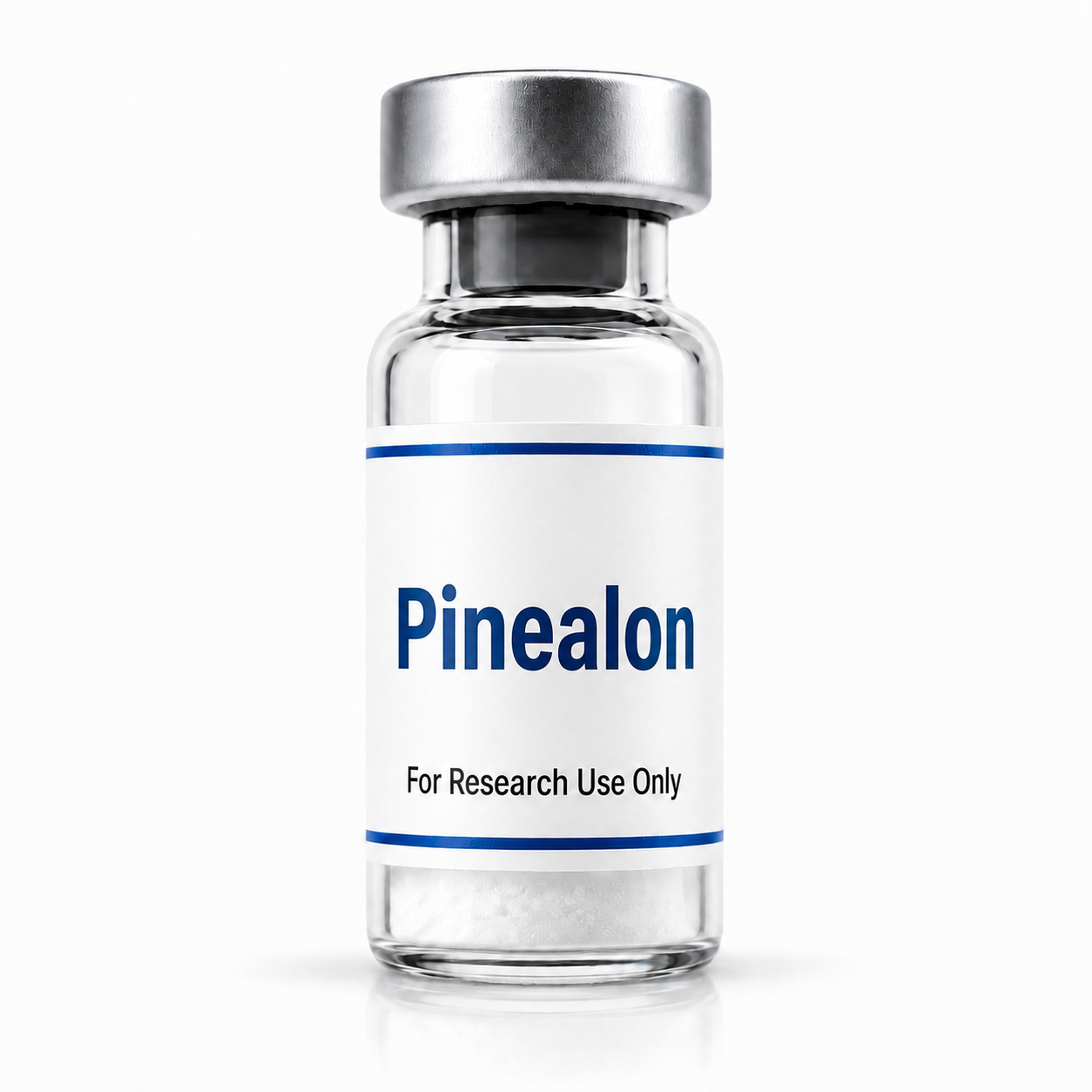
Pinealon
Every price, divided down to the milligram.
Sticker prices hide what a compound actually costs, because vial sizes differ. So we divide the listing by its stated peptide content and show the real cost per milligram.
Vendors pay us a commission when you buy through our links. It never changes the order — rows are sorted by measured price per mg, and every flag is computed from the data shown. Read the full disclosure
Where to buy
One listing trackedHow this page is funded: vendors listed here pay us a commission when you buy through our links. Commissions never change the ranking — rows are ordered by measured price per mg, and flags are computed from the data on this page. Sponsored placements, if any, are always labeled.
On this page
How to read these rows
Verify the COA
A certificate of analysis should come from an independent lab, reference the exact batch number on the label, and be recent. Vendor-issued documents without a named third-party lab carry less weight — the COA row links to what each vendor publishes.
Match the format
Lyophilized vials and sprays are different products with different concentrations. That is why sprays sit outside the $/mg ranking — compare vials to vials, sprays to sprays.
Count the total cost
Shipping fees, free-shipping thresholds and active discount codes can flip which vendor is actually cheapest for your order size. The $/mg figure is the baseline; the shipping and code details finish the math.
How we rank
The row below carries a price per mg figure: listed price divided by stated peptide content, excluding shipping and codes. It is the same calculation applied on every compound page, so a figure here is directly comparable to one anywhere else on the site.
We currently track a single listing for this compound. When a second vendor is added the rows are ordered by measured $/mg, and the flags for testing and shipping are computed from the data shown. Each row carries its own verification date.
About Pinealon
Designations
Pinealon · EDR peptide · T-33 peptide · glutamylaspartylarginine
Class : short peptide bioregulator
- Class
- short peptide bioregulator
Formula derivation
Glu (147.13) + Asp (133.10) + Arg (174.20) sum to 454.43 as free amino acids. Removing two waters for the two peptide bonds gives 418.40, and element counts resolve to C15H26N6O8.
Storage and handling
- Appearance
- solid, lyophilized powder
- Solubility
- water at 40 mg/mL (95.60 mM), requiring sonication and warming to 37 °C
- Storage, lyophilized
- −20 °C, sealed, away from moisture and light
- Stock solution
- −80 °C up to 6 months; −20 °C up to 1 month
- Handling
- aliquot to avoid repeated freeze-thaw
Note on solubility
This is the practical detail most vendor pages omit. Dissolution is not instantaneous — reported protocols call for warming to 37 °C and ultrasonic agitation. A vial that appears not to dissolve on first attempt is behaving as expected.
A mass-spectrometry note
Pinealon shares its carbon, hydrogen and nitrogen counts with the AHK tripeptide used in copper peptides: C15H26N6O8 versus C15H26N6O4. The two differ only by four oxygens, placing them exactly 64 Da apart at 418.40 and 354.40. They are readily distinguished by mass, but the shared C/H/N composition is worth knowing if both are handled in the same workflow.
The Khavinson family
Pinealon is one of a set of ultra-short peptide bioregulators developed by Vladimir Khavinson and colleagues at the St Petersburg Institute of Bioregulation and Gerontology. The family shares a design logic rather than a single target.
Common features
Two to four residues, built from acidic and basic amino acids Small enough and appropriately charged to cross both the plasma membrane and the nuclear envelope Proposed to act on DNA directly rather than through a cell-surface receptor Each member associated with a tissue or organ system
Related members encountered in the same catalogues Epitalon (Ala-Glu-Asp-Gly) · Vilon · Livagen · Cortagen · Cardiogen · Chonluten · Vesugen · Cartalax · Bronchogen · Thymalin · Prostamax · Ovagen · Pancragen · Testagen · Crystagen · Vesilute · Thymagen
Pinealon and Epitalon, the two best-known members, both carry the Glu-Asp core, which is characteristic of the acidic bioregulators.
Origin
EDR is described as derived from Cortexin, a crude polypeptide extract of brain cortex. Cortexin appears repeatedly in this literature as the comparator preparation, and the distinction matters — Pinealon is a single defined tripeptide, Cortexin is an undefined mixture.
Mechanism: why this one is unusual
The claim that separates Pinealon from most peptides in a catalogue is that it does not act at a receptor.
Reported mechanism
Pinealon does not appear to bind cell-surface or cytoplasmic receptors. Work with fluorescence-labelled short peptides in HeLa cells reported penetration of both the plasma membrane and the nuclear membrane, with sequence-specific interaction with deoxyribooligonucleotides and DNA in vitro.
(Fedoreyeva et al., Biochemistry Moscow, 2011)
The proposed consequence is epigenetic: site-specific peptide-DNA binding modulating transcription, rather than signal transduction from a receptor. This is a mechanistic claim about gene regulation and should be read as such — it is the framework the Khavinson literature works within, not a settled consensus position.
Oxidative stress and ERK signalling
The best-characterized experimental findings. In rat cerebellar granule cells:
Pinealon at 10, 50 and 100 nM for 30 minutes dose-dependently prevented the rise in reactive oxygen species induced by ouabain Pinealon at 10 nM suppressed ERK 1/2 activation in cells exposed to homocysteine Reported reduction in necrotic cell death by propidium iodide staining, accompanied by delayed ERK 1/2 activation (Khavinson et al., Rejuvenation Research, 2011)
The framing is that ROS act as second messengers in MAPK/ERK signalling, so lowering ROS attenuates pathway activation and reduces apoptotic signalling.
Excitotoxicity
Homocysteine exposure is used as the stressor because it activates NMDA receptors, driving calcium influx and ROS production. Pinealon is reported to raise resistance to hypoxic stress and reduce NMDA excitotoxic potential via endogenous antioxidant enzyme systems.
Antioxidant enzymes
Reported activation of SOD2 and GPX1.
Serotonin synthesis
A specific and testable proposal: Pinealon is reported to bind the promoter region of the tryptophan hydroxylase gene, increasing TPH expression and therefore serotonin synthesis. Molecular docking reported more negative binding energy for Pinealon against DNA than for comparator bioregulators, with an approximately 1.9-fold increase in serotonin synthesis reported in younger cell cultures.
(Khavinson et al., Bulletin of Experimental Biology and Medicine, 2014)
Apoptosis and cytokines
Reported modulation of caspase-3 and p53, and normalization of IL-6 and TNF-α in models of acute hypoxic hypoxia in old rats. The reported contrast with Cortexin is the interesting part: Cortexin lowered cell death but left IL-6 elevated, while Pinealon returned the markers toward baseline.
(Mendzheritskii et al., Advances in Gerontology, 2014)
Alzheimer's and Huntington's models
Reported preservation of dendritic spines and reduced neuronal apoptosis, with the gene-expression framework set out in the Molecules review.
(Khavinson et al., Molecules, 2021)
Irisin and telomeres
Reported alteration of irisin expression in muscle cells, with irisin discussed in relation to telomere length.
(Khavinson et al., Bulletin of Experimental Biology and Medicine, 2016)
In vivo and clinical reports
These are largely Russian-language studies in gerontology journals with small samples and limited independent replication. Reported at face value below.
Learning and memory, rats
Pinealon at 50, 100 and 200 ng/kg by injection for 5 days showed a dose-dependent effect on maintenance of a previously acquired skill.
(Karantysh et al., Neurochemical Journal, 2020)
Prenatal hyperhomocysteinemia, rats
Pinealon at 10 µg/kg daily for 5 days protected offspring, with reported improvement in cognitive function and reductions in oxidative stress and neuronal necrosis.
(Arutjunyan et al., Int J Clin Exp Med, 2012)
Skin cell cultures
Reported promotion of cell proliferation and blocking of apoptosis in dermal and epidermal cells from both young and old rats.
(Voicekhovskaya et al., Bull Exp Biol Med, 2012)
Occupational stress
A study in professional lorry drivers reported improved resistance to work-related stress and reduced incidence of borderline mental disorders.
(Bashkireva & Artamonova, Advances in Gerontology, 2012)
Older adults with organic brain syndrome
In patients aged 41 to 83 with chronic polymorbidity, reported anabolic and neuroprotective effects with slowed aging indicators, and no change in chromatin condensation — offered as evidence of genetic safety. The same study reported Vesugen as showing stronger geroprotective effect than Pinealon.
(Meshchaninov et al., Advances in Gerontology, 2015)
Regulatory status
Pinealon is not approved by the FDA for any indication, and is not approved as a drug or dietary supplement. The evidence base is predominantly in vitro and animal work, with a small number of Russian-language clinical reports that have not been independently replicated.
Material supplied for laboratory use is a research chemical. It is not a drug, food, cosmetic, or dietary supplement, has not been evaluated by the FDA, and is not intended for human or veterinary use.
Specifications
| Attribute | Value |
|---|---|
| Molecular formula | C15H26N6O8 |
| Molecular weight | 418.40 g/mol |
| CAS Number | 175175-23-2 |
| PubChem CID | 10273502 ↗ |
| Residue count | 3 |
| Sequence | Glu-Asp-Arg |
| Written | H-Glu-Asp-Arg-OH |
| One-letter | EDR |
| Full name | L-glutamyl-L-aspartyl-L-arginine |