Bioregulator Compounds · Checked
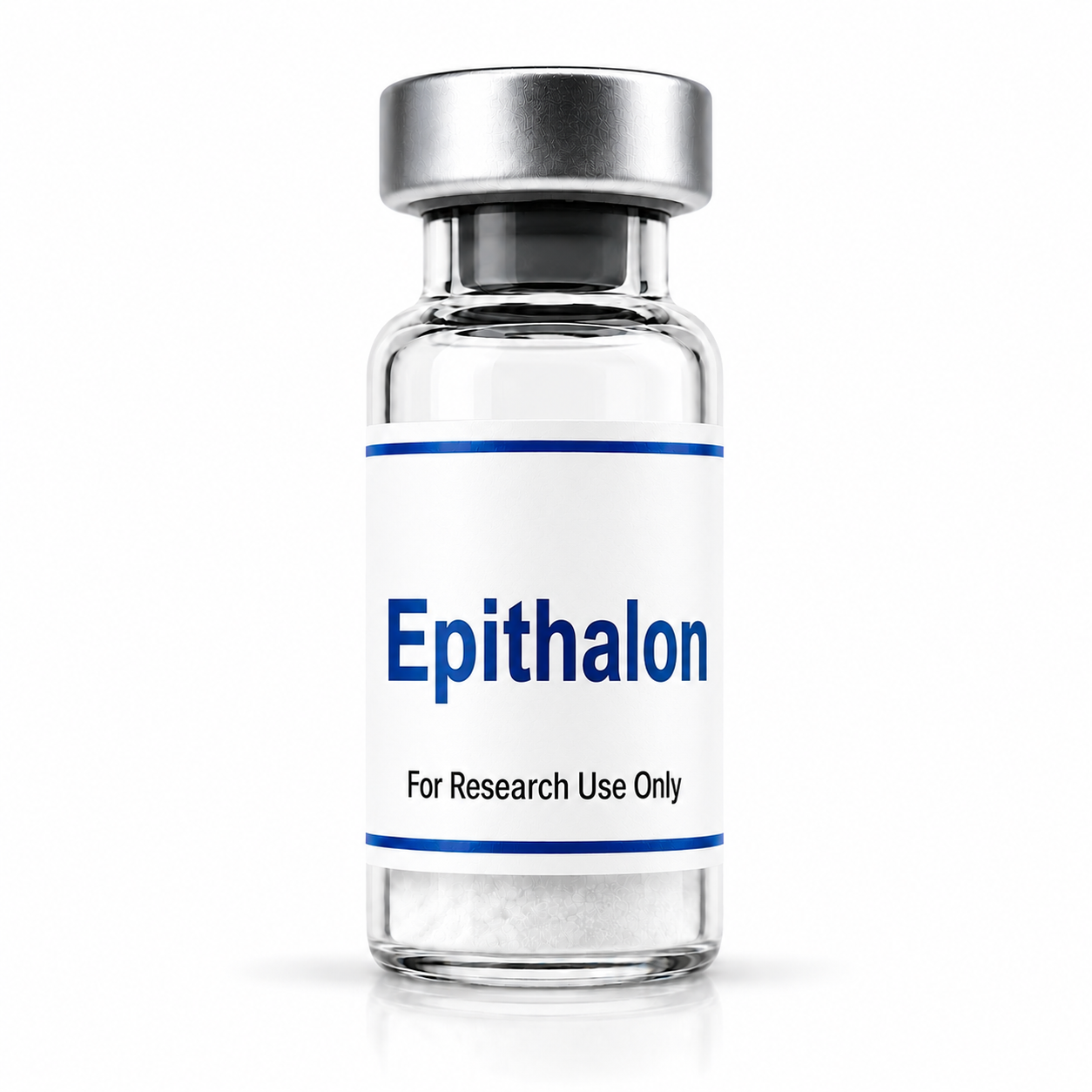
Epithalon (Epitalon)
Every price, divided down to the milligram.
Vendors sell this compound in different vial sizes at different prices, which makes sticker prices useless for comparison. So we divide every listing by its stated peptide content and rank what comes out.
Vendors pay us a commission when you buy through our links. It never changes the order — rows are sorted by measured price per mg, and every flag is computed from the data shown. Read the full disclosure
Ranked by $ per mg
Sprays listed after the vials, unrankedHow this page is funded: vendors listed here pay us a commission when you buy through our links. Commissions never change the ranking — rows are ordered by measured price per mg, and flags are computed from the data on this page. Sponsored placements, if any, are always labeled.
On this page
How to read these rows
Verify the COA
A certificate of analysis should come from an independent lab, reference the exact batch number on the label, and be recent. Vendor-issued documents without a named third-party lab carry less weight — the COA row links to what each vendor publishes.
Match the format
Lyophilized vials and sprays are different products with different concentrations. That is why sprays sit outside the $/mg ranking — compare vials to vials, sprays to sprays.
Count the total cost
Shipping fees, free-shipping thresholds and active discount codes can flip which vendor is actually cheapest for your order size. The $/mg figure is the baseline; the shipping and code details finish the math.
How we rank
Rows are ordered by price per mg: listed price divided by stated peptide content, excluding shipping and codes, so every vial competes on the same axis. Each row carries its own $/mg figure, so the size of the gap between vendors is visible, not just the order. Sprays follow the vials, unranked.
The best-documented testing flag goes to the vendor publishing batch-level, third-party certificates. The shipping flag goes to the fastest published delivery from a domestic warehouse. Data is re-checked on a schedule and each row carries its verification date.
Pineal-derived telomerase-modulating tetrapeptide
AEDG tetrapeptide (Epitalon) — the most-researched telomerase activator for longevity and senescence-focused.
A synthetic 4-residue peptide (Ala-Glu-Asp-Gly) characterised in the primary literature by the Khavinson group as a modulator of telomerase activity and pineal-gland gene expression in preclinical models. For laboratory characterisation only.
Epithalon (Epitalon) — clinical & mechanistic profile
Epithalon is a synthetic tetrapeptide (AEDG) that activates telomerase via hTERT upregulation. A September 2025 Biogerontology study confirmed dose-dependent telomere extension in normal epithelial, fibroblast, and cancer cell lines. Brunel University (2025) independently replicated telomere lengthening across cell types. Additional 2025 data shows it restores antioxidant genes (SOD2, catalase, HO-1) and prevents DNA hypomethylation in hyperglycemic retinal cells.
Studied applications
- Telomerase activation
- upregulates hTERT mRNA, activating telomerase during G1 cell cycle phase via TRAP protocol confirmation
- Telomere elongation
- extends telomeres approximately 33.3% in somatic cells, increases proliferative potential beyond Hayflick limit
- Cell lifespan extension
- treated fetal fibroblasts reached 44+ passages vs. 34 for controls
- Histone H1 binding
- binds H1.3 and H1.6 variants, potentially triggering ALT pathways via H19 derepression
- Anti-tumor effects
- reduces spontaneous tumors and metastases in mice; inhibits MMP9 in aging skin fibroblasts
Research constraints & safety notes
- Most research originates from a limited number of research groups (primarily Russian)
- Limited independent replication in Western research institutions
- No FDA-approved human applications or completed Phase 3 trials
- Telomerase activation in humans not confirmed in rigorous clinical trials
- Long-term safety of telomerase activation uncertain (theoretical cancer concerns)
Product Description
What Epithalon (Epitalon) is
Epithalon (Epitalon) is a synthetic tetrapeptide (4 amino acids). Epithalon is a synthetic tetrapeptide (AEDG) that activates telomerase via hTERT upregulation. A September 2025 Biogerontology study confirmed dose-dependent telomere extension in normal epithelial, fibroblast, and cancer cell lines. Brunel University (2025) independently replicated telomere lengthening across cell types. Additional 2025 data shows it restores antioxidant genes (SOD2, catalase, HO-1) and prevents DNA hypomethylation in hyperglycemic retinal cells. It has a molecular formula C14H22N4O9, mass 390.35 Da. Its published amino-acid sequence is Ala-Glu-Asp-Gly. Common synonyms in the literature include Epitalon, Epithalone, and AEDG peptide.
What it’s studied for
Investigation of Epithalon (Epitalon) to date is primarily preclinical, with the majority of citations concentrated in animal models and in-vitro assays rather than randomized controlled human trials. Published work referencing Epithalon (Epitalon) spans Human cell culture studies: Research in human fetal lung fibroblasts, epithelial cells (HMEC, IBR.3), and lymphocytes has examined Epithalon's effects on telomerase activity and telomere length. Studies using the TRAP (Telomere Repeat Amplification Protocol) assay reported telomere extensions up to 33.3% on average in some lymphocyte studies, Telomerase gene expression: Experiments showed Epithalon upregulates hTERT (the catalytic subunit of telomerase) mRNA expression, with effects occurring primarily during the G1 phase of the cell cycle. The peptide reportedly enters cell nuclei and binds to promoter regions containing ATTTC motifs, and Cancer cell comparisons: In cancer cell lines (21NT, BT474, HeLa), Epithalon was observed to extend telomeres primarily through the ALT (Alternative Lengthening of Telomeres) pathway rather than telomerase activation, suggesting selectivity for healthy cells. This selectivity has been proposed as a safety feature. Proposed mechanisms in the literature include hTERT upregulation: increases telomerase catalytic subunit mRNA expression primarily during G1 cell cycle phase and Chromatin modification: enters cell nuclei, binds promoter regions (ATTTC motifs) for epigenetic activation. None of this material describes therapeutic outcomes in humans, and No vendor listed here provides dosing guidance for Epithalon (Epitalon) outside laboratory research.
Related research
For the full mechanistic profile, published references, and constraint notes on Epithalon (Epitalon), see the Epithalon (Epitalon) research page. All references cited on that page are peer-reviewed primary literature.
For research use only. This summary is a research-scientific overview compiled from peer-reviewed sources. It is not medical advice and is not intended for human or veterinary consumption.
Receptor engagement in the primary literature
Binding and functional-assay data for Epithalon (Epitalon), from peer-reviewed in-vitro pharmacology publications. Values are receptor activity parameters — not clinical outcomes.
In-vitro human fibroblast cultures report increased TERT expression and telomerase activity following epitalon exposure, sustained over multiple passages.
Source: Khavinson et al., Bull Exp Biol Med 2003
Preclinical rodent studies describe epitalon-mediated normalisation of pineal melatonin rhythms, most pronounced in aged animals.
Source: Anisimov et al., Neuroendocrinol Lett 2003
In-vitro / preclinical characterisation only — no clinical or therapeutic claim is expressed or implied. Research use only.
Investigational context
Study designs referencing this compound in the published literature. Descriptions cover framework only — phase, participant count, duration, and citation — not outcomes. Click a card to review the source directly.
Specifications
| Attribute | Value |
|---|---|
| Molecular Formula | C14H22N4O9 |
| CAS Number | 307297-39-8 |
| Molecular Weight | 390.35 g/mol |
| Sequence | Ala-Glu-Asp-Gly |
| Sequence length | 4 residues |
| Physical form | Lyophilized powder |
| PubChem CID | 219042 ↗ |