Regenerative Peptide · Checked
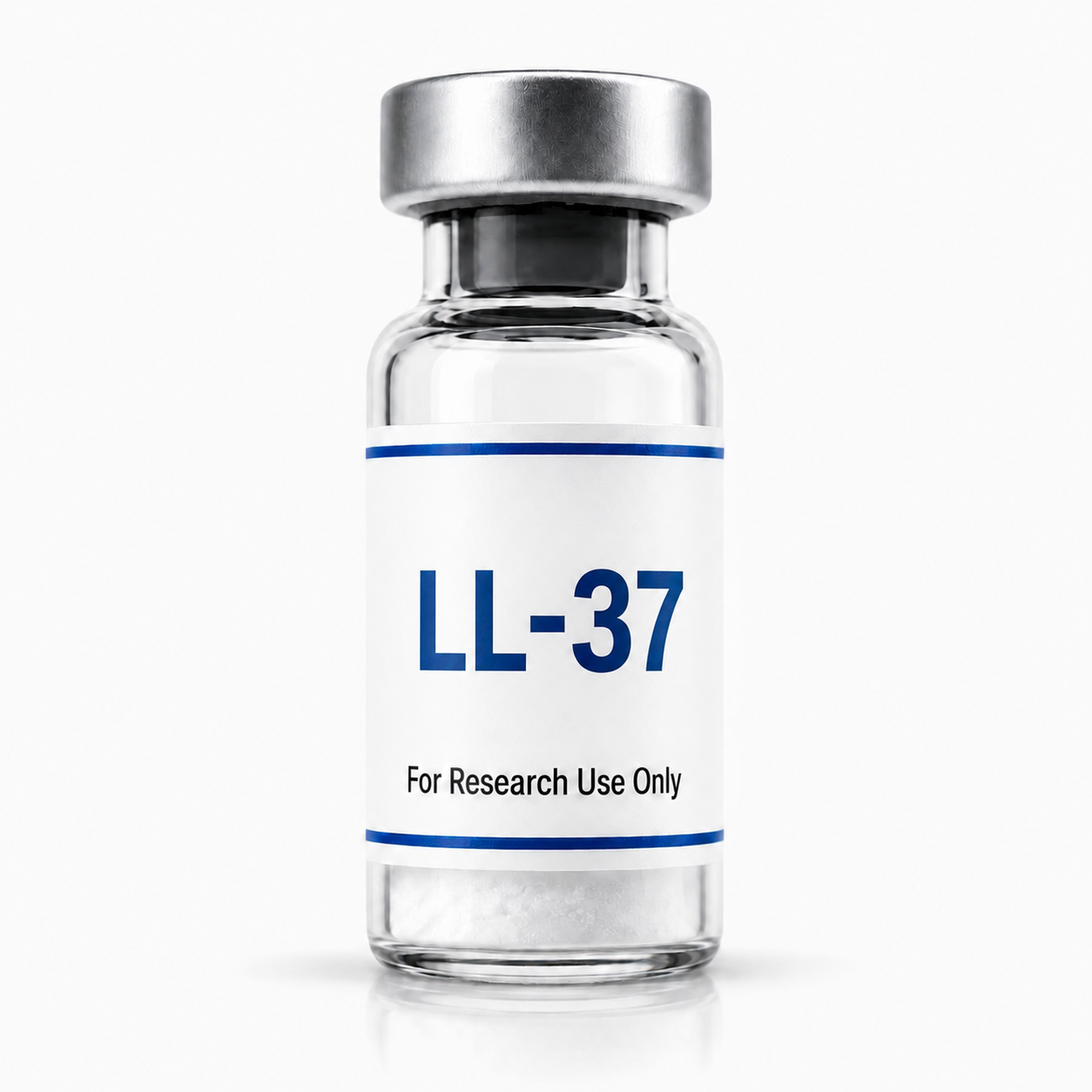
LL-37
Every price, divided down to the milligram.
Sticker prices hide what a compound actually costs, because vial sizes differ. So we divide the listing by its stated peptide content and show the real cost per milligram.
Vendors pay us a commission when you buy through our links. It never changes the order — rows are sorted by measured price per mg, and every flag is computed from the data shown. Read the full disclosure
Where to buy
One listing trackedHow this page is funded: vendors listed here pay us a commission when you buy through our links. Commissions never change the ranking — rows are ordered by measured price per mg, and flags are computed from the data on this page. Sponsored placements, if any, are always labeled.
On this page
How to read these rows
Verify the COA
A certificate of analysis should come from an independent lab, reference the exact batch number on the label, and be recent. Vendor-issued documents without a named third-party lab carry less weight — the COA row links to what each vendor publishes.
Match the format
Lyophilized vials and sprays are different products with different concentrations. That is why sprays sit outside the $/mg ranking — compare vials to vials, sprays to sprays.
Count the total cost
Shipping fees, free-shipping thresholds and active discount codes can flip which vendor is actually cheapest for your order size. The $/mg figure is the baseline; the shipping and code details finish the math.
How we rank
The row below carries a price per mg figure: listed price divided by stated peptide content, excluding shipping and codes. It is the same calculation applied on every compound page, so a figure here is directly comparable to one anywhere else on the site.
We currently track a single listing for this compound. When a second vendor is added the rows are ordered by measured $/mg, and the flags for testing and shipping are computed from the data shown. Each row carries its own verification date.
About LL-37
Written in full
H-Leu-Leu-Gly-Asp-Phe-Phe-Arg-Lys-Ser-Lys-Glu-Lys-Ile-Gly-Lys- Glu-Phe-Lys-Arg-Ile-Val-Gln-Arg-Ile-Lys-Asp-Phe-Leu-Arg-Asn-Leu- Val-Pro-Arg-Thr-Glu-Ser-OH
- Structure class
- cationic, amphipathic, α-helical
- Appearance
- white lyophilized powder
- Solubility
- aqueous laboratory buffers
Designations and synonyms
LL-37 · CAP-18 · hCAP-18 · Cathelicidin LL-37 · Antibacterial peptide LL-37 · FALL-39 · CRAMP (murine ortholog) · HSD26 · Ropocamptide (INN)
Where the name comes from
Two N-terminal leucine residues and a length of 37 residues. Amino Club's account of this is correct.
Where FALL-39 comes from
The peptide was originally described as FALL-39, a 39-residue form beginning Phe-Ala-Leu-Leu. LL-37 is the processed 37-residue form, two residues shorter at the N-terminus. Both names persist in catalogues and databases, and FALL-39 appears in supplier synonym lists as though it were an alias — it is a different length of the same peptide.
Ropocamptide
The INN assigned to LL-37 as a drug candidate. Worth knowing, because it is the name the clinical trial literature uses.
A useful internal consistency check
LL-37 contains no methionine and no cysteine. A correct molecular formula therefore has no sulfur. C205H340N60O53 satisfies this. Any supplier listing a sulfur-containing formula for LL-37 has an error.
One supplier examined lists C205H340N50O53 — N50 rather than N60.
Their own stated molecular weight of 4493.34 only resolves with N60, so this is a transcription error rather than a different species.
The only human cathelicidin
Mammals carry cathelicidin genes in varying numbers. Humans have exactly one, CAMP, and LL-37 is its only antimicrobial product.
Every other compound in a peptide catalogue has analogues and relatives; this one is singular in the human genome. That is the fact worth leading with.
Origin and release
hCAP-18 is the 18 kDa precursor stored in neutrophil secondary granules and expressed by epithelial cells, keratinocytes and macrophages. LL-37 is released by proteolytic cleavage from its C-terminus. Expression rises sharply on injury or infection rather than being maintained at constant levels.
Structure and mechanism
The peptide is cationic and amphipathic and adopts an α-helix under physiological conditions. The cationic face is attracted to anionic microbial membranes; the hydrophobic face inserts. Disruption is described as detergent-like or "carpet" mode rather than discrete pore formation, with oligomerization reported and activity against both zwitterionic and negatively charged membranes.
Reported to retain activity in high-salt environments, though methicillin-resistant S. aureus and Candida albicans show resistance under those conditions.
LPS neutralization
LL-37 binds lipopolysaccharide directly. This contributes both to antibacterial action against Gram-negatives and to blunting of endotoxin-driven inflammation — the basis for the description of LL-37 as an LPS-neutralizing, pleiotropic peptide.
Receptors
Chemotactic activity is reported through formyl peptide receptor-like 1 (FPRL1 / FPR2) for neutrophils, monocytes and T cells, and through a Gi-phospholipase C pathway independent of FPRL1 for mast cells. Eosinophil and neutrophil chemoattraction via formyl-peptide receptors is also reported.
Wound-healing effects are reported to involve transactivation of the epidermal growth factor receptor with downstream MAPK and PI3K/Akt signalling.
Nucleic acid handling involves scavenger receptors, with SR-A6 and SR-B1 named, and clathrin-mediated endocytosis.
The double-edged problem
This is the part most vendor pages omit, and it is the single most important thing for anyone writing about LL-37 to understand.
LL-37 complexes with self nucleic acids. Those complexes are immunostimulatory — they enable self-DNA and self-RNA to reach and activate intracellular nucleic acid sensors that would normally ignore them. The consequence is that LL-37 is implicated as a driver in autoimmune disease, not only as a defensive peptide.
Reported associations include psoriasis, systemic lupus
erythematosus, rheumatoid arthritis and atherosclerosis. The literature title "Between good and evil: complexation of the human cathelicidin LL-37 with nucleic acids" captures the position accurately.
Context dependence is the rule, not the exception Reported effects invert depending on cell type and inflammatory environment:
TLR4 signalling suppressed in some models
TLR3 signalling enhanced in others, reported to be pH-dependent T cells pro-inflammatory when resting, anti-inflammatory when activated Cancer models both antitumor and pro-tumorigenic effects reported, varying by tumor type Arthritis models LL-37 deficiency reported not to change disease outcome, suggesting elevated cathelicidin may be incidental rather than causal in that setting
Practical consequence
"Antimicrobial peptide, therefore beneficial" is not a defensible framing for this compound. The honest framing is a context-dependent immune modulator with a documented role on both sides of inflammatory disease. Cytotoxicity at higher concentrations and rapid proteolytic degradation are also cited as the principal obstacles to therapeutic development.
Clinical and research context
Venous leg ulcers — the real clinical programme Unusually for this catalogue, LL-37 has randomized placebo-controlled human trial data. A Phase I/II trial in hard-to-heal venous leg ulcers reported the treatment safe and effective in enhancing healing, with reported reduction in ulcer size of up to 68% at optimal doses, and a dose-response in which the highest dose was less effective than intermediate doses. A later multicentric prospective randomized placebo-controlled trial followed.
(Grönberg et al., Wound Repair Regen, 2014; Mahlapuu et al., 2021)
Wound healing and re-epithelialization
Reported enhancement of keratinocyte migration and proliferation via EGFR transactivation. LL-37 is reported to be essential for re-epithelialization of skin wounds and to be absent or reduced in chronic ulcer epithelium — a deficiency finding rather than a supplementation claim.
(Heilborn et al., J Invest Dermatol, 2003; Carretero et al., 2008)
Biofilms
Reported inhibition of biofilm formation and disruption of mature biofilms, including on titanium alloy surfaces — relevant to implant-associated infection.
(Ridyard & Overhage, 2021; Wei et al., 2021)
Sepsis
Reported inhibition of macrophage pyroptosis with improved survival in polybacterial septic mice.
(Hu et al., Int Immunol, 2016)
Cardiac
Reported protection against myocardial ischemia/reperfusion injury via Akt and ERK1/2 activation with nuclear export of FoxO3a, and reported association between lower LL-37 levels and worse outcomes after myocardial infarction.
(Bei et al., BMC Medicine, 2019; Miao et al., Pharmacol Res, 2024)
Angiogenesis
Reported induction of angiogenesis through PGE2-EP3 signalling in endothelial cells, with in vivo inhibition by aspirin — a specific and testable mechanism.
(Salvado et al., ATVB, 2013)
Anti-inflammatory signalling
Reported reduction of IL-6, IL-8 and TNF-α with enhanced mitochondrial biogenesis, described as mTOR-dependent.
(Sun et al., Int J Biochem Cell Biol, 2014)
COPD
Lower circulating LL-37 reported in patients at high risk of frequent exacerbations.
(Yang et al., J Thorac Dis, 2015)
Mucosal and ocular immunity
Expressed by corneal and conjunctival epithelia, with reported antibacterial and antiviral activity at the ocular surface.
(Gordon et al., Curr Eye Res, 2005)
Gastrointestinal
Reported roles in intestinal epithelial migration and barrier maintenance, reduction of TNF-related cell death in combination with beta-defensin 2, and expression changes in inflammatory bowel disease. TLR3 activation by poly(I:C) reported to induce LL-37 expression via TRIF, TRAF6 and TAK1.
(Kusaka et al., 2018; Piktel et al., 2016)
Delivery and stabilization
Because proteolytic degradation limits utility, engineering work includes a collagen-binding-domain variant reported to improve retention on collagen wound dressings.
(Wei, Rolle & Camesano, ACS Omega, 2023)
Regulatory status
LL-37 is an endogenous human peptide. As a drug candidate it carries the INN ropocamptide and has completed randomized placebo-controlled trials in venous leg ulcers, but it is not approved by the FDA or any other regulatory agency for any indication.
Material supplied for laboratory use is a research chemical. It is not a drug, food, cosmetic, or dietary supplement, has not been evaluated by the FDA, and is not intended for human or veterinary use.
Svensson D, Nilsson BO. Human antimicrobial/host defense peptide LL-37 may prevent the spread of a local infection through multiple mechanisms: an update. Inflamm Res. 2025;74(1):36.
PMCID PMC11893641
Specifications
| Attribute | Value |
|---|---|
| Molecular formula | C205H340N60O53 |
| Molecular weight | 4493 g/mol |
| CAS Number | 154947-66-7 |
| PubChem CID | 16198951 ↗ |
| Gene | CAMP |
| Parent protein | hCAP-18 (human cathelicidin, |
| Residue count | 37 |