Peptide Secretagogue Analogs · Checked
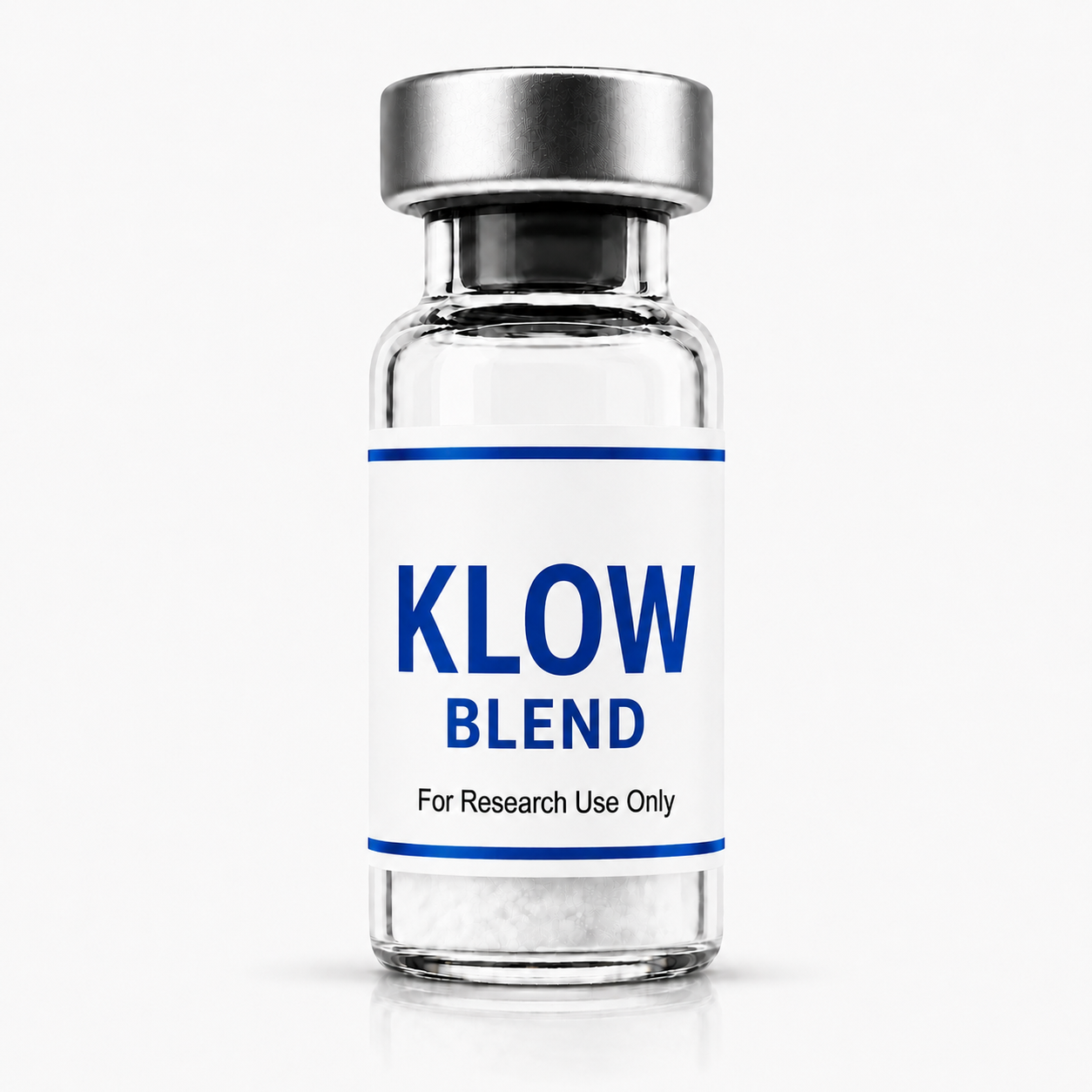
KLOW Blend
Every price, divided down to the milligram.
Vendors sell this compound in different vial sizes at different prices, which makes sticker prices useless for comparison. So we divide every listing by its stated peptide content and rank what comes out.
Vendors pay us a commission when you buy through our links. It never changes the order — rows are sorted by measured price per mg, and every flag is computed from the data shown. Read the full disclosure
Ranked by $ per mg
Sprays listed after the vials, unrankedHow this page is funded: vendors listed here pay us a commission when you buy through our links. Commissions never change the ranking — rows are ordered by measured price per mg, and flags are computed from the data on this page. Sponsored placements, if any, are always labeled.
On this page
How to read these rows
Verify the COA
A certificate of analysis should come from an independent lab, reference the exact batch number on the label, and be recent. Vendor-issued documents without a named third-party lab carry less weight — the COA row links to what each vendor publishes.
Match the format
Lyophilized vials and sprays are different products with different concentrations. That is why sprays sit outside the $/mg ranking — compare vials to vials, sprays to sprays.
Count the total cost
Shipping fees, free-shipping thresholds and active discount codes can flip which vendor is actually cheapest for your order size. The $/mg figure is the baseline; the shipping and code details finish the math.
How we rank
Rows are ordered by price per mg: listed price divided by stated peptide content, excluding shipping and codes, so every vial competes on the same axis. Each row carries its own $/mg figure, so the size of the gap between vendors is visible, not just the order. Sprays follow the vials, unranked.
The best-documented testing flag goes to the vendor publishing batch-level, third-party certificates. The shipping flag goes to the fastest published delivery from a domestic warehouse. Data is re-checked on a schedule and each row carries its verification date.
About KLOW Blend
Quad-peptide regenerative blend — GHK-Cu + TB-500 + BPC-157 + KPV. The most complete tissue-repair stack available.
KPV is a synthetic tripeptide (C-terminal α-MSH fragment). KPV is the C-terminal tripeptide of α-MSH that exerts anti-inflammatory effects via PepT1 transport and NF-κB inhibition, independent of melanocortin receptors. Reduces disease activity in murine colitis by >50%, suppresses LPS-induced cytokines by 60% in macrophages, and shows direct antimicrobial activity against S. aureus and C. albicans while sparing mammalian cells. It has a molecular formula C16H30N4O4, mass 342.43 Da. Its published amino-acid sequence is Lys-Pro-Val. Common synonyms in the literature include α-MSH fragment, Alpha-MSH 11-13, and Lys-Pro-Val. This SKU is a co-formulated blend that also contains GHK-Cu in the same vial — for research groups that want to combine the two under a single reconstitution.
What it’s studied for
Investigation of KPV to date is primarily preclinical, with the majority of citations concentrated in animal models and in-vitro assays rather than randomized controlled human trials. Published work referencing KPV spans NF-κB inhibition studies: In vitro research in macrophages, intestinal epithelial cells, and other cell types demonstrates KPV suppresses NF-κB activation in response to LPS, IL-1β, or TNF-α stimulation. This reduces downstream transcription of inflammatory genes, Gut inflammation models: Studies in colonic inflammation models show KPV promotes mucosal healing, downregulates TNF-α expression, and protects against ulcerative damage when delivered to inflamed intestinal tissue, and IL-1 receptor antagonism research: KPV mimics the KPT loop of IL-1 receptor antagonist degradation products, binding IL-1RI to terminate IL-1β signaling. This represents a melanocortin receptor-independent anti-inflammatory mechanism. Proposed mechanisms in the literature include PepT1 intracellular uptake: transported via PepT1 (required for activity; blocking with Gly-Leu abolishes effects) and NF-κB pathway inhibition: inside cells, inhibits NF-κB activation via interactions with nuclear transport proteins (importins). None of this material describes therapeutic outcomes in humans, and No vendor listed here provides dosing guidance for KPV outside laboratory research.
Related research
For the full mechanistic profile, published references, and constraint notes on KPV, see the KPV research page. All references cited on that page are peer-reviewed primary literature.
Research use only. KLOW Blend is sold strictly for in-vitro and animal research. It is not a drug, food, supplement, or cosmetic and is not intended for human or veterinary consumption. No statements on this page describe or imply any therapeutic effect.