Cellular Peptide · Checked
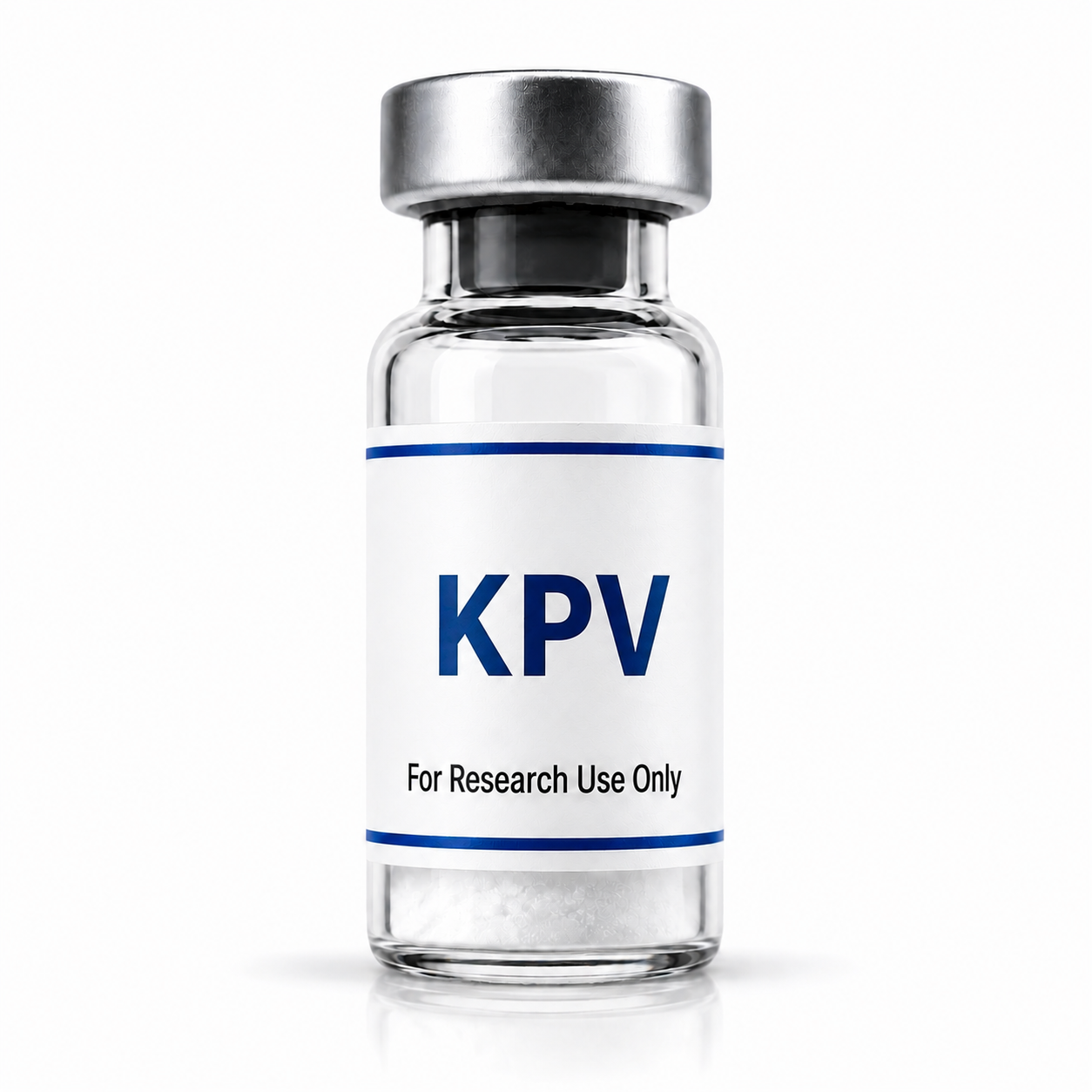
KPV
Every price, divided down to the milligram.
Sticker prices hide what a compound actually costs, because vial sizes differ. So we divide the listing by its stated peptide content and show the real cost per milligram.
Vendors pay us a commission when you buy through our links. It never changes the order — rows are sorted by measured price per mg, and every flag is computed from the data shown. Read the full disclosure
Where to buy
One listing trackedHow this page is funded: vendors listed here pay us a commission when you buy through our links. Commissions never change the ranking — rows are ordered by measured price per mg, and flags are computed from the data on this page. Sponsored placements, if any, are always labeled.
On this page
How to read these rows
Verify the COA
A certificate of analysis should come from an independent lab, reference the exact batch number on the label, and be recent. Vendor-issued documents without a named third-party lab carry less weight — the COA row links to what each vendor publishes.
Match the format
Lyophilized vials and sprays are different products with different concentrations. That is why sprays sit outside the $/mg ranking — compare vials to vials, sprays to sprays.
Count the total cost
Shipping fees, free-shipping thresholds and active discount codes can flip which vendor is actually cheapest for your order size. The $/mg figure is the baseline; the shipping and code details finish the math.
How we rank
The row below carries a price per mg figure: listed price divided by stated peptide content, excluding shipping and codes. It is the same calculation applied on every compound page, so a figure here is directly comparable to one anywhere else on the site.
We currently track a single listing for this compound. When a second vendor is added the rows are ordered by measured $/mg, and the flags for testing and shipping are computed from the data shown. Each row carries its own verification date.
About KPV
IUPAC name
(2S)-2-[[(2S)-1-[(2S)-2,6-diaminohexanoyl]pyrrolidine-2-carbonyl] amino]-3-methylbutanoic acid
SMILES
CC(C)[C@@H](C(=O)O)NC(=O)[C@@H]1CCCN1C(=O)[C@H](CCCCN)N
Origin
C-terminal residues 11-13 of α-melanocyte-stimulating hormone (α-MSH), a 13-residue peptide hormone.
First characterized
Hiltz ME, Lipton JM. Antiinflammatory activity of a COOH-terminal fragment of the neuropeptide alpha-MSH. FASEB J. 1989;3(11):2282-4.
Physical
- Appearance
- white lyophilized powder
- Solubility
- water
Melanocortin receptor relationship
α-MSH engages melanocortin receptors (MC1R, MC3R, MC4R, MC5R) through the central His-Phe-Arg-Trp (HFRW) tetrapeptide pharmacophore at residues 6-9. The C-terminal Lys-Pro-Val tripeptide does not contain that motif.
Multiple primary studies report KPV anti-inflammatory activity that proceeds without melanocortin-receptor signaling. Kannengiesser et al. (2008) examined the MC1R contribution specifically and described KPV activity as at least partially independent of MC1R.
KPV carries no reported pigmentary action, in contrast to the parent hormone.
PepT1 transport
KPV is taken up by intestinal epithelial and immune cells via the PepT1 peptide transporter. Transport is required for activity; competitive blockade abolishes the effect. Dalmasso et al. (2008) established this route. Viennois et al. (2016) examined PepT1 in colitis-associated models.
NF-κB inhibition
Once internalized, KPV inhibits NF-κB activation and nuclear translocation, reported at nanomolar concentrations.
MAP-kinase signaling
Reported modulation alongside NF-κB.
Cytokine output
Reported reductions in TNF-α and other pro-inflammatory cytokines in intestinal and epithelial cell models. Xiao et al. (2017) reported TNF-α downregulation in colonic tissue.
Nitric oxide involvement
Bonfiglio et al. (2006) reported accelerated corneal epithelial re-epithelialization with KPV exposure, an effect attenuated by pre-treatment with the nitric oxide synthase inhibitor L-NAME, indicating NO involvement in that model.
Structural note
The central proline imposes a conformational constraint that the structure-activity literature treats as material to activity.
Research context
Intestinal inflammation — the largest body of work PepT1-mediated uptake reducing intestinal inflammation (Dalmasso 2008); murine IBD models with reported reductions in inflammatory infiltrate and myeloperoxidase activity (Kannengiesser 2008); hyaluronic-acid-functionalized nanoparticle oral delivery in ulcerative colitis (Xiao 2017); hydrogel-based delivery systems (Sun 2021, Zhao 2022).
Dermatology and wound models
α-MSH and related tripeptides, anti-inflammatory and protective effects (Brzoska 2008); keratinocyte signaling (Elliott 2004); murine incisional wound healing and scar area (de Souza 2015).
Ophthalmic
Corneal epithelial wound healing and the role of nitric oxide (Bonfiglio 2006).
Respiratory
Inhibition of inflammation cues in bronchial epithelial cells (Land 2012).
Structure-activity
Dissection of the anti-inflammatory effect of core and C-terminal α-MSH peptides (Getting 2003); structural modification by reductive glycoalkylation of the lysine residue (Songok 2018).
Thermoregulation
Effect of α-MSH 11-13 on fever in the rabbit (Richards & Lipton 1984).
Analytical methods
Stability-indicating HPLC assay for KPV in aqueous solutions and skin homogenates (Pawar 2015); transdermal iontophoretic delivery across microporated skin (Pawar 2017).
Routes studied
Oral, topical, transdermal, and intraperitoneal.
Regulatory status
KPV is not approved as a drug by the FDA, EMA, or any other regulatory agency. No approved formulation exists in any jurisdiction. It is supplied as a research chemical for in-vitro and preclinical laboratory use only.
Specifications
| Attribute | Value |
|---|---|
| Molecular formula | C16H30N4O4 |
| Molecular weight | 342.43 g/mol |
| CAS Number | 67727-97-3 |
| PubChem CID | 125672 ↗ |
| ChemSpider | 111779 |
| ChEBI | CHEBI:160254 |
| EPA CompTox | DTXSID80987067 |
| InChIKey | YSPZCHGIWAQVKQ-AVGNSLFASA-N |
| Residue count | 3 |
| Sequence | Lys-Pro-Val (K-P-V) |
| Full form | H-Lys-Pro-Val-OH — free N-terminus, |
| Structure class | synthetic tripeptide |
| Additional designations | MSH (11-13), ACTH (11-13), α-MSH (11-13) |