Metabolic Research Peptide · Checked
Cagrilintide
Every price, divided down to the milligram.
Sticker prices hide what a compound actually costs, because vial sizes differ. So we divide the listing by its stated peptide content and show the real cost per milligram.
Vendors pay us a commission when you buy through our links. It never changes the order — rows are sorted by measured price per mg, and every flag is computed from the data shown. Read the full disclosure
Where to buy
One listing trackedHow this page is funded: vendors listed here pay us a commission when you buy through our links. Commissions never change the ranking — rows are ordered by measured price per mg, and flags are computed from the data on this page. Sponsored placements, if any, are always labeled.
On this page
How to read these rows
Verify the COA
A certificate of analysis should come from an independent lab, reference the exact batch number on the label, and be recent. Vendor-issued documents without a named third-party lab carry less weight — the COA row links to what each vendor publishes.
Match the format
Lyophilized vials and sprays are different products with different concentrations. That is why sprays sit outside the $/mg ranking — compare vials to vials, sprays to sprays.
Count the total cost
Shipping fees, free-shipping thresholds and active discount codes can flip which vendor is actually cheapest for your order size. The $/mg figure is the baseline; the shipping and code details finish the math.
How we rank
The row below carries a price per mg figure: listed price divided by stated peptide content, excluding shipping and codes. It is the same calculation applied on every compound page, so a figure here is directly comparable to one anywhere else on the site.
We currently track a single listing for this compound. When a second vendor is added the rows are ordered by measured $/mg, and the flags for testing and shipping are computed from the data shown. Each row carries its own verification date.
About Cagrilintide
Backbone origin
Cagrilintide is built on a pramlintide-like 37-residue backbone rather than on native human amylin. This is a deliberate design choice: human amylin is prone to amyloid fibril formation, and building from the pramlintide scaffold avoids that liability while retaining full receptor agonist activity.
Acylation
N-terminal acylation with a C20 eicosanedioic fatty diacid, attached through a gamma-glutamic acid linker. The diacid promotes reversible albumin binding, which is the basis of the compound's extended duration of action.
Disulfide
Intramolecular disulfide bridge.
Half-life
Reported elimination half-life of 159–195 hours, described in Novo Nordisk trial documentation as approximately 180 hours — a profile supporting once-weekly subcutaneous administration.
Receptor pharmacology
Cagrilintide is characterized as a non-selective agonist across the calcitonin receptor family.
AMY1R amylin receptor 1 — calcitonin receptor + RAMP1 AMY2R amylin receptor 2 — calcitonin receptor + RAMP2 AMY3R amylin receptor 3 — calcitonin receptor + RAMP3 CTR calcitonin receptor, unmodified
Amylin receptors are not distinct gene products. They are heterodimers formed when the calcitonin receptor associates with one of three receptor activity-modifying proteins (RAMP1, RAMP2, RAMP3). That architecture is why an amylin analog inevitably engages the calcitonin receptor as well, and why cagrilintide is described in the literature as a dual amylin and calcitonin receptor agonist rather than a selective amylin agonist.
Signaling
In receptor assays, cagrilintide couples primarily to Gs and cyclic AMP signaling.
Sites of action
Preclinical work localizes activity to the area postrema and the hypothalamus — brain regions associated with satiation signaling and energy-balance regulation.
Structural pharmacology
Cryo-EM and molecular dynamics work has characterized cagrilintide binding to both calcitonin and amylin receptors, describing the structural basis of its non-selective profile (Cao et al., Nature Communications, 2025).
Phase 2 dose-finding — cagrilintide monotherapy
Trial NN9838-4433. A 26-week randomized, double-blind, placebo-controlled and active-controlled trial in 706 adults with obesity or overweight plus at least one weight-related comorbidity.
Participants received once-weekly subcutaneous cagrilintide at 0.3, 0.6, 1.2, 2.4 or 4.5 mg, placebo, or once-daily liraglutide 3.0 mg, alongside lifestyle intervention.
Reported outcomes at week 26, from a baseline of approximately 100 kg: cagrilintide 4.5 mg 10.8% weight reduction cagrilintide 2.4 mg 9.7% weight reduction placebo 3.0% weight reduction
All cagrilintide doses exceeded placebo on the primary endpoint.
The most frequently reported adverse events were gastrointestinal and injection-site reactions, characterized as non-serious and mild to moderate.
(Lau et al., The Lancet, 2021)
Phase 1b — combination with semaglutide
A randomized controlled trial examining safety, tolerability, pharmacokinetics and pharmacodynamics of multiple doses of cagrilintide administered concomitantly with semaglutide 2.4 mg.
(Enebo et al., The Lancet, 2021)
CagriSema — the combination programme
CagriSema is a fixed co-formulation of cagrilintide 2.4 mg with semaglutide 2.4 mg. It is two distinct peptides rather than a single molecule, and therefore has no single CAS number, molecular formula, or molecular weight. Semaglutide is a separate compound with its own identity: CAS 910463-68-2, molecular weight approximately 4113.6 g/mol.
Phase 3 REDEFINE programme results as reported: REDEFINE 1 22.7% weight reduction at 68 weeks, adults with obesity REDEFINE 2 13.7% weight reduction, adults with type 2 diabetes
A Phase 3 trial in adults with type 2 diabetes examined the combination in that population (NCT04982575).
(Garvey et al., New England Journal of Medicine, 2025)
Comparative receptor-balance research
Work comparing cagrilintide with other dual amylin and calcitonin receptor agonists has examined whether the relative balance of amylin versus calcitonin receptor activity affects metabolic outcomes in preclinical models.
(Larsen et al., Biomedicine & Pharmacotherapy, 2022)
Amylin biology
Reviews of amylin's role in feeding and satiation provide the physiological context for this compound class.
(Lutz, Neuropharmacology, 2025)
Class amylin analog GLP-1 agonist GLP-1/GIP dual agonist Receptor targets AMY1/2/3R + CTR GLP-1R GLP-1R + GIPR Pathway count single (amylin) single (GLP-1) dual CAS 1415456-99-3 910463-68-2 — Molecular weight 4409.01 g/mol ~4113.6 g/mol — Research value isolates amylin reference GLP-1 multi-incretin receptor pathway pathway signaling interaction
Literature on one of these compounds does not transfer to the others.
Regulatory status
Cagrilintide is an investigational compound. It is not approved for any indication by the FDA, EMA, or any other regulatory agency, either as monotherapy or as part of the CagriSema combination.
Material supplied for laboratory use is a research chemical. It is not a drug, food, cosmetic, or dietary supplement, has not been evaluated by the FDA, and is not intended for human or veterinary use.
Specifications
| Attribute | Value |
|---|---|
| Molecular formula | C194H312N54O59S2 |
| Molecular weight | 4409.01 g/mol |
| CAS Number | 1415456-99-3 |
| PubChem CID | 171397054 ↗ |
| PubChem CID (acetate) | 164618153 |
| Residue count | 37 |
| Peptide class | long-acting acylated amylin analog |
| Developer | Novo Nordisk A/S |
| Development designations | AM833 · NN9838 · NN0174-0833 |
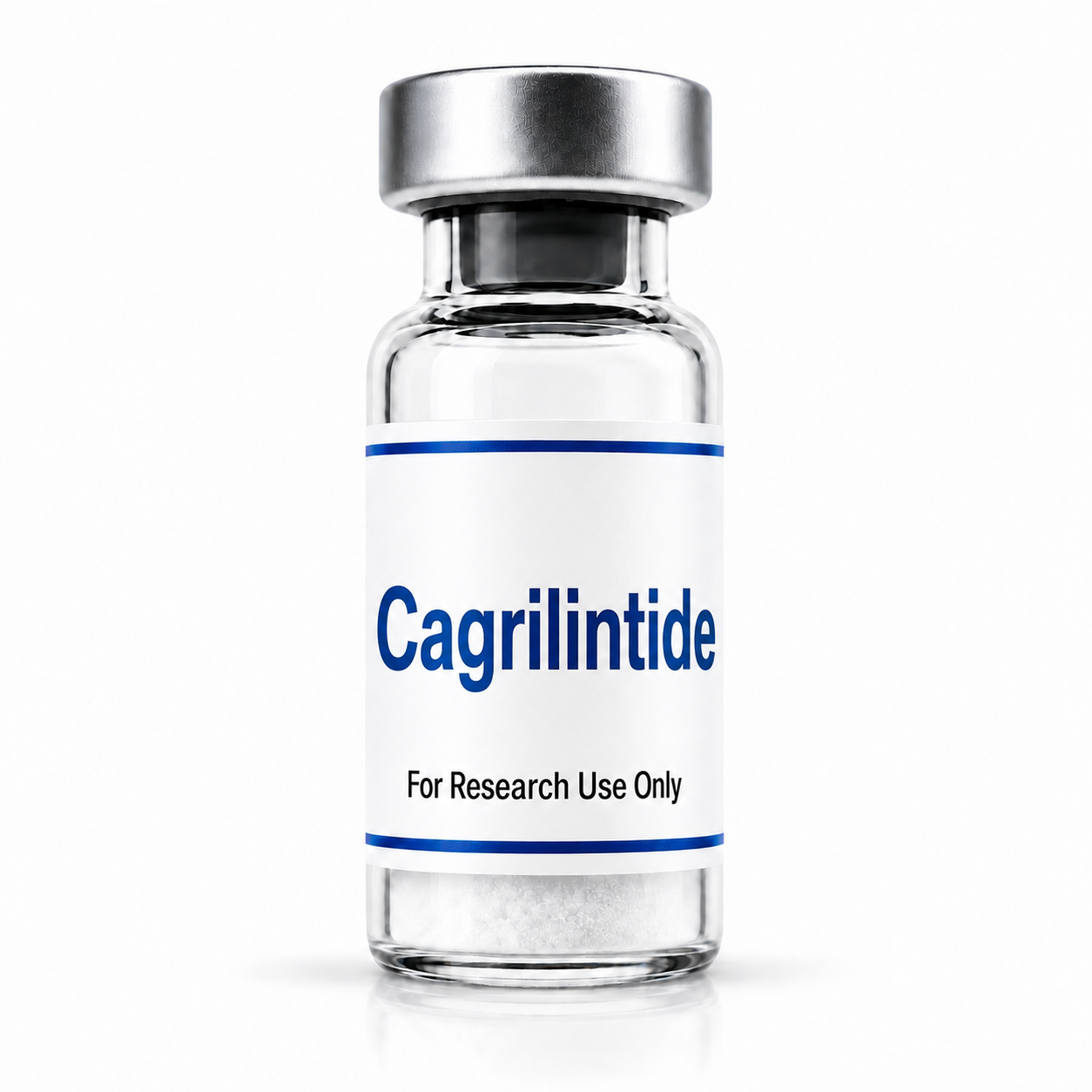
| Appearance | white to off-white lyophilized powder |