Category : Cellular Peptide · Checked
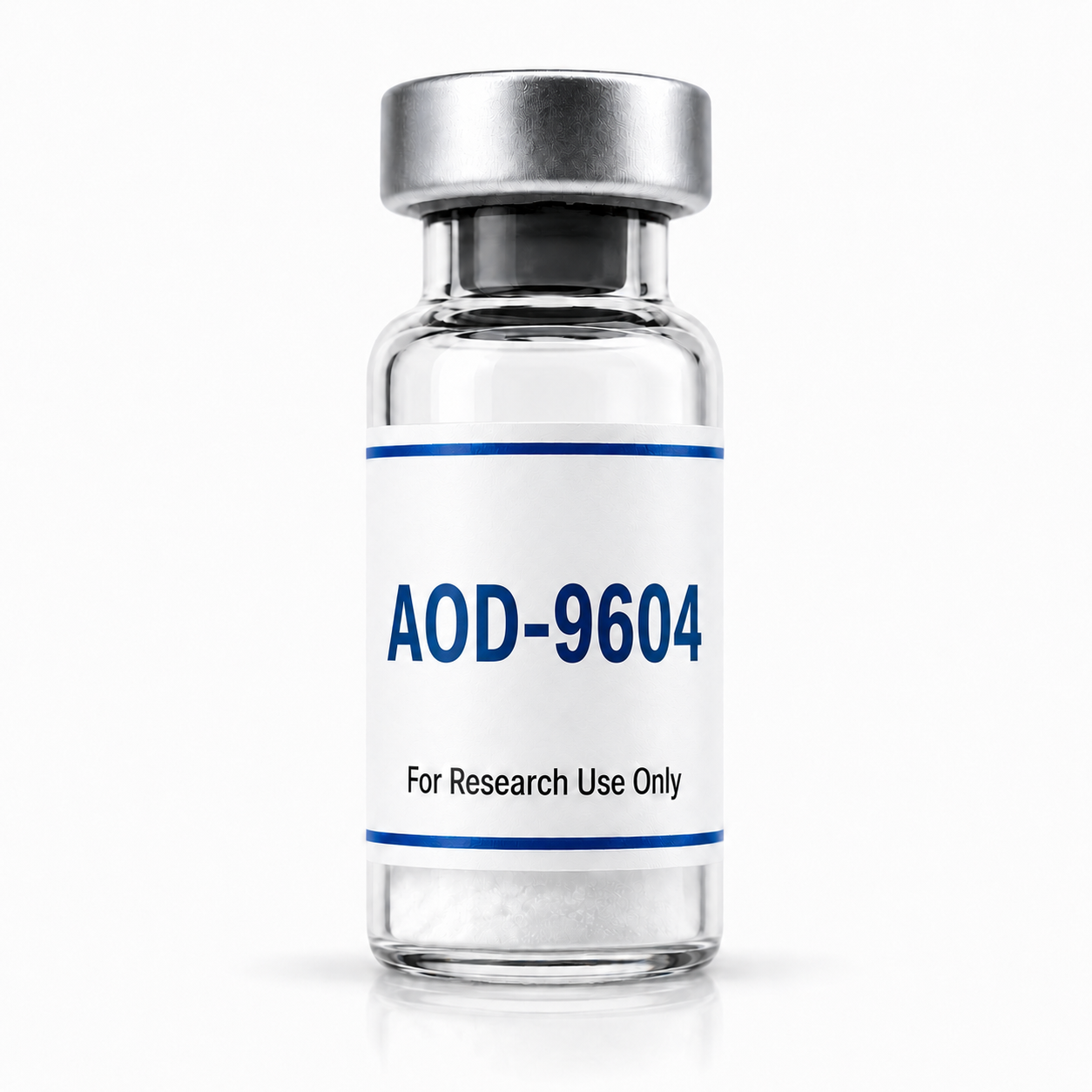
AOD-9604
Every price, divided down to the milligram.
Sticker prices hide what a compound actually costs, because vial sizes differ. So we divide the listing by its stated peptide content and show the real cost per milligram.
Vendors pay us a commission when you buy through our links. It never changes the order — rows are sorted by measured price per mg, and every flag is computed from the data shown. Read the full disclosure
Where to buy
One listing trackedHow this page is funded: vendors listed here pay us a commission when you buy through our links. Commissions never change the ranking — rows are ordered by measured price per mg, and flags are computed from the data on this page. Sponsored placements, if any, are always labeled.
On this page
How to read these rows
Verify the COA
A certificate of analysis should come from an independent lab, reference the exact batch number on the label, and be recent. Vendor-issued documents without a named third-party lab carry less weight — the COA row links to what each vendor publishes.
Match the format
Lyophilized vials and sprays are different products with different concentrations. That is why sprays sit outside the $/mg ranking — compare vials to vials, sprays to sprays.
Count the total cost
Shipping fees, free-shipping thresholds and active discount codes can flip which vendor is actually cheapest for your order size. The $/mg figure is the baseline; the shipping and code details finish the math.
How we rank
The row below carries a price per mg figure: listed price divided by stated peptide content, excluding shipping and codes. It is the same calculation applied on every compound page, so a figure here is directly comparable to one anywhere else on the site.
We currently track a single listing for this compound. When a second vendor is added the rows are ordered by measured $/mg, and the flags for testing and shipping are computed from the data shown. Each row carries its own verification date.
About AOD-9604
A 16-residue lipolytic fragment of human growth hormone, studied for fat metabolism without the growth-promoting activity of the parent hormone.
What it is
AOD-9604 is the C-terminal lipolytic domain of human growth hormone — residues 177–191 — with an N-terminal tyrosine substituted for the phenylalanine at position 176. That substitution is why the systematic designation is Tyr-hGH(177-191), and why the residue count is sixteen rather than fifteen: one added tyrosine plus fifteen native residues. The molecule carries an intramolecular disulfide bridge between Cys7 and Cys14.
It was developed from work at Monash University in Melbourne in the 1990s and licensed to Metabolic Pharmaceuticals, which took it through a company-sponsored clinical programme.
A note on what lipolysis means
Lipolysis is the hydrolysis of stored triglycerides into glycerol and free fatty acids inside the adipocyte. The fat cell itself is not destroyed. Product copy describing lipolysis as “the breakdown or destruction of fat cells” conflates it with adipocyte death, which is a different process and is not what the AOD-9604 literature reports.
Reported mechanism
- Beta-3 adrenergic pathway
- reported upregulation of beta-3 adrenergic receptor expression in adipose tissue
- Lipoprotein lipase
- reported direct inhibition of adipose tissue lipoprotein lipase
- Lipogenesis
- reported inhibition via acetyl-CoA carboxylase
- IGF-1 axis
- does not stimulate IGF-1; a pooled analysis reports no effect on serum IGF-1 and none on insulin sensitivity
- Oral bioavailability
- once-daily oral dosing reported active in obese Zucker rats
Clinical history
Approximately six company-sponsored trials were run, across roughly 900 subjects. A pooled analysis of six randomised controlled trials reported no effect on serum IGF-1 and no effect on insulin sensitivity (Stier et al., 2013).
The pivotal 24-week Phase 2B trial — the OPTIONS study, reported in 2007 — did not beat placebo on its primary weight endpoint. The compound was subsequently pursued as a nutraceutical ingredient rather than a drug (Stier et al., 2014). It is not approved as a drug in any jurisdiction. Any summary citing that trial without stating the outcome is incomplete.
Distinguishing it from hGH Fragment 176-191
AOD-9604 and hGH Fragment 176-191 differ by a single oxygen atom, and are not reliably resolvable by HPLC alone — mass spectrometry is required to tell them apart. An identity claim resting on chromatographic purity alone does not establish which of the two is in the vial.
Storage and handling
- Appearance
- white to off-white lyophilized powder
- Solubility
- readily soluble in water
- Storage, lyophilized
- −20 °C, protected from light and moisture
- Storage, reconstituted
- 2–8 °C
- Freeze-thaw
- minimise cycles; aliquot for long-term storage
One supplier reports that 0.6% acetic acid may be required for reconstitution and that plain research-grade water can cause gelling. No other source examined mentions this, so treat it as a single-source observation rather than consensus guidance — but worth knowing before a first reconstitution.
Specifications
| Molecular formula | C78H123N23O23S2 |
|---|---|
| Molecular weight | 1815.1 g/mol |
| Monoisotopic mass | 1813.8604 Da |
| CAS Number | 221231-10-3 |
| PubChem CID | 71300630 ↗ |
| InChIKey | GVIYUKXRXPXMQM-BPXGDYAESA-N |
| Residue count | 16 |
| Sequence | Tyr-Leu-Arg-Ile-Val-Gln-Cys-Arg-Ser-Val-Glu-Gly-Ser-Cys-Gly-Phe |
| One-letter | YLRIVQCRSVEGSCGF |
| Disulfide bridge | Cys7–Cys14 (intramolecular) |
| Systematic designation | Tyr-hGH(177-191) |
| Origin | C-terminal fragment of human growth hormone, residues 177-191 |
The residue count is sixteen, not fifteen: Tyr-hGH(177-191) is one added tyrosine plus fifteen native residues, and the compound is described in the primary literature as a hexadecapeptide. In-vitro / preclinical characterisation only — no clinical or therapeutic claim is expressed or implied. Research use only.