Cognitive Peptide · Checked
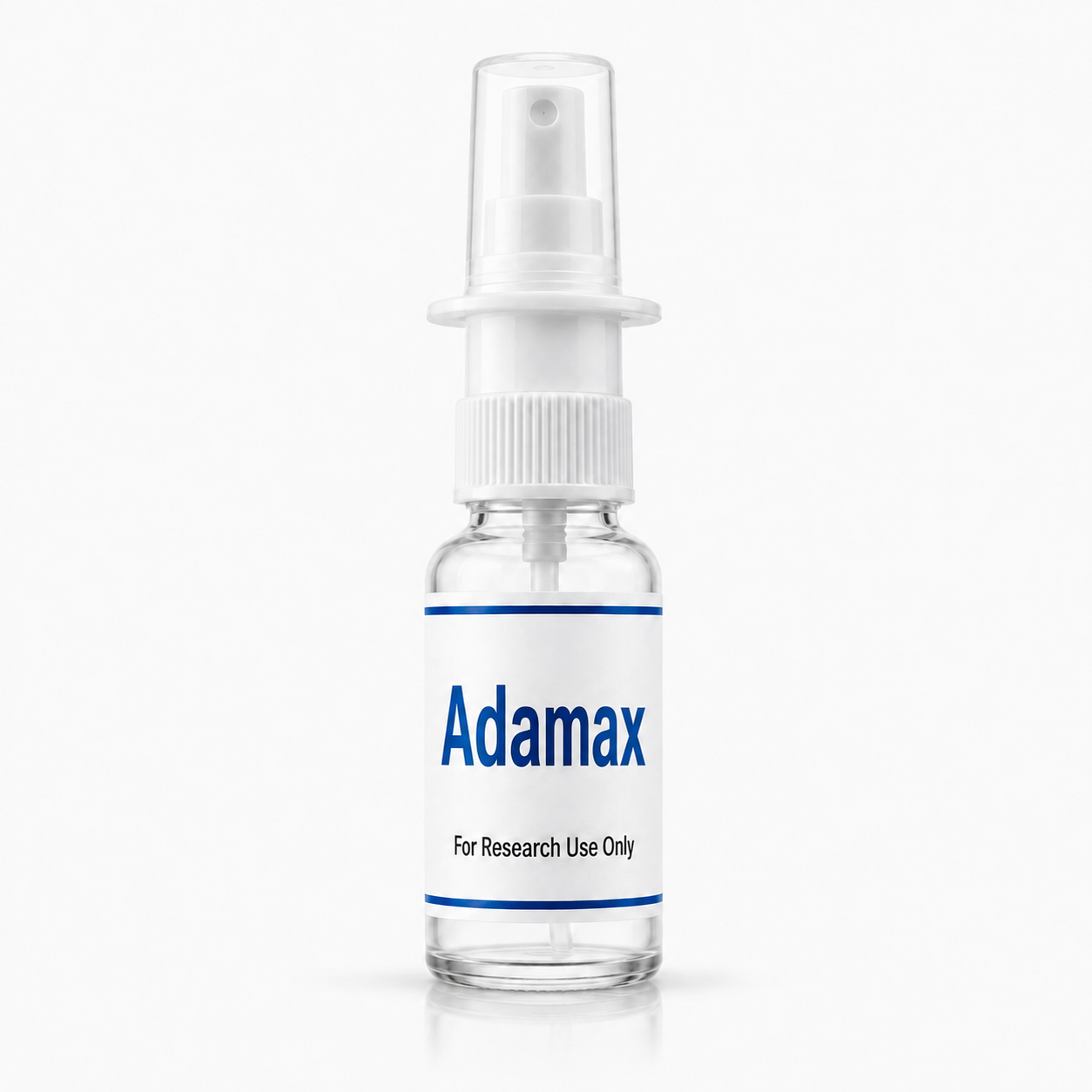
Adamax Spray
Every price, divided down to the milligram.
Sticker prices hide what a compound actually costs, because vial sizes differ. So we divide the listing by its stated peptide content and show the real cost per milligram.
Vendors pay us a commission when you buy through our links. It never changes the order — rows are sorted by measured price per mg, and every flag is computed from the data shown. Read the full disclosure
Where to buy
One listing trackedHow this page is funded: vendors listed here pay us a commission when you buy through our links. Commissions never change the ranking — rows are ordered by measured price per mg, and flags are computed from the data on this page. Sponsored placements, if any, are always labeled.
On this page
How to read these rows
Verify the COA
A certificate of analysis should come from an independent lab, reference the exact batch number on the label, and be recent. Vendor-issued documents without a named third-party lab carry less weight — the COA row links to what each vendor publishes.
Match the format
Lyophilized vials and sprays are different products with different concentrations. That is why sprays sit outside the $/mg ranking — compare vials to vials, sprays to sprays.
Count the total cost
Shipping fees, free-shipping thresholds and active discount codes can flip which vendor is actually cheapest for your order size. The $/mg figure is the baseline; the shipping and code details finish the math.
How we rank
The row below carries a price per mg figure: listed price divided by stated peptide content, excluding shipping and codes. It is the same calculation applied on every compound page, so a figure here is directly comparable to one anywhere else on the site.
We currently track a single listing for this compound. When a second vendor is added the rows are ordered by measured $/mg, and the flags for testing and shipping are computed from the data shown. Each row carries its own verification date.
About Adamax Spray
This compound has no dedicated peer-reviewed studies of its own. The mechanism and research shown below belong to its parent compound, Semax. Extrapolating that profile onto this analog is a working hypothesis, not a documented fact — the terminal modifications can change pharmacokinetics and target affinity.
The endotoxin values are not in conflict — they are different reporting limits rather than different measurements. "NMT 0.05" and "< 1.25" both state that nothing was detected above the respective assay threshold. The content figures agree to within about 1.5%.
One display inconsistency: the QC panel header reads "5 passed · 2 reported" while the lot card states "8 assays passed," and the Appearance row present on their other products is absent here — reasonable for a solution rather than a powder, but it makes the count read inconsistently.
The name says adamantane
"Adamax," "N-Acetyl Semax Adamantane," and "Adamantane Semax" all imply an adamantyl group — a rigid tricyclic C10H15 cage commonly used in medicinal chemistry to raise lipophilicity and metabolic stability.
The sequence contains no adamantane
Every supplier examined that publishes a sequence gives the same one:
That is Semax (Met-Glu-His-Phe-Pro-Gly-Pro) extended at the C-terminus by Ala-Gly and acetylated at the N-terminus. There is no adamantyl group in it. An adamantyl substituent would add roughly 134 Da; an adamantane-1-carbonyl group roughly 162 Da.
The contradiction originates upstream
It is not a single vendor's error. Conscientia Industrial, a manufacturer, describes the compound in prose as "modified with N-acetyl and adamantane groups to enhance its metabolic stability and lipophilicity" and then lists the sequence as Ac-Met-Glu-His-Phe-Pro-Gly-Pro-Ala-Gly-OH on the same page.
At least one supplier acknowledges the problem One supplier states that Adamax and Adamantane Semax are used interchangeably, that multiple technical references describe an adamantane modification, and advises researchers to compare listed specifications because naming conventions vary between suppliers.
Practical position
The material sold as Adamax is specified by suppliers as an acetylated nonapeptide. The "adamantane" element of the name is not supported by any published sequence found. Anyone sourcing this compound should verify against the lot mass spectrum rather than the product name.
Sequence (consistent across suppliers)
Ac-Met-Glu-His-Phe-Pro-Gly-Pro-Ala-Gly-OH Ac-MEHFPGPAG
- Residue count
- 9, N-acetylated
- Parent compound
- Semax, ACTH(4-7)-Pro-Gly-Pro
- CAS Number
- not assigned
- Class
- synthetic nonapeptide, Semax analog
Relationship to Semax
Semax Met-Glu-His-Phe-Pro-Gly-Pro 7 residues Adamax Ac-Met-Glu-His-Phe-Pro-Gly-Pro-Ala-Gly 9 residues, N-acetylated
Two modifications relative to Semax: an N-terminal acetyl cap and a C-terminal Ala-Gly extension. Both are conventional strategies for slowing aminopeptidase and carboxypeptidase cleavage.
Molecular formula and weight — conflicting values Suppliers publishing the same sequence report different formulas.
Only one pair is arithmetically consistent with that sequence.
- Consistent with the sequence
- C44H61N11O13S · 984.1 g/mol
- Also published elsewhere
- C50H69N11O11S · 1032.55 g/mol
Working from the sequence: the nine residues sum to 1086.17 Da as free amino acids. Removing eight waters for the eight peptide bonds gives 942.01. Adding the N-terminal acetyl group (+42.04) gives 984.05, and element counts resolve to C44H61N11O13S.
The first pair therefore agrees with the sequence published for this compound.
The alternative figure differs from it by +C6H8 −O2, which does not correspond to acetylation, amidation, adamantylation, or any other standard modification, and cannot be reconciled with the same sequence.
Use C44H61N11O13S / 984.05 for the acetylated nonapeptide, and treat a reported mass near 1032 as describing a different or incorrectly specified material.
Physical form
This listing is supplied as a ready-to-use solution. Lyophilized powder is the more common format elsewhere:
Appearance (powder) white to off-white lyophilized powder Solubility water; also DMSO Purity spec ≥ 98.0% HPLC typical Water content ≤ 8.0% (manufacturer spec) Acetate content ≤ 15.0% (manufacturer spec) Storage (powder) −20 °C, sealed, protected from light and moisture Shelf life (powder) 24 months
The acetate specification matters for anyone calculating concentration. Up to 15% of a lyophilized mass may be acetate counterion rather than peptide, which is why net peptide content by HPLC is the figure to work from rather than vial fill weight.
The position is therefore:
Semax a genuine literature, including Russian clinical work and mechanistic studies on BDNF/TrkB Adamax no published studies under this name; no CAS number assigned; no independent pharmacology
Every mechanistic statement below is Semax data. None of it has been demonstrated for the nonapeptide. The two modifications that define Adamax — acetylation and C-terminal extension — are exactly the kind of change that can alter potency, receptor interaction and metabolic fate, so extrapolation is an assumption rather than a finding.
Origin
Semax is a synthetic heptapeptide derived from ACTH(4-10). It comprises the ACTH(4-7) fragment Met-Glu-His-Phe with a C-terminal Pro-Gly-Pro tripeptide, which confers resistance to enzymatic degradation. Developed in Russia, where it has regulatory approval for certain neurological indications.
BDNF and TrkB
The central mechanistic finding. Semax has been reported to regulate BDNF and TrkB expression in rat hippocampus, positioning the compound as acting on neurotrophic signalling rather than as a classical receptor agonist.
(Dolotov et al., Brain Research, 2006)
Neurotrophin time-course
Comparative work on the temporal dynamics of NGF and BDNF gene expression across rat hippocampus, frontal cortex and retina under Semax.
(Shadrina et al., Journal of Molecular Neuroscience, 2010)
Ischemia and gene expression
In rat focal cerebral ischemia, Semax affected expression of genes related to immune and vascular systems — a transcriptome-level rather than single-target account.
(Medvedeva et al., BMC Genomics, 2014)
Clinical work in stroke
Russian clinical literature reports efficacy at different stages of ischemic stroke. Published in Russian-language neurology journals and not independently replicated outside that literature.
(Zhurnal Nevrologii i Psikhiatrii imeni S.S. Korsakova, 2018)
Molecular-level review
A review of protective properties of ACTH(4-7)PGP at the molecular level.
(International Journal of Molecular Sciences, 2020)
Independent assessment
The Alzheimer's Drug Discovery Foundation maintains a Cognitive Vitality review of Semax, useful as a non-vendor appraisal of the strength of the evidence.
Regulatory status
Adamax is not an approved drug in any jurisdiction. It has no assigned CAS number and no dedicated clinical or preclinical literature under this name.
Semax, the parent compound, holds regulatory approval in Russia for certain neurological indications. It is not FDA-approved, and approval of a parent compound in one jurisdiction confers nothing on an analogue.
Material supplied for laboratory use is a research chemical. It is not a drug, food, cosmetic, or dietary supplement, has not been evaluated by the FDA, and is not intended for human or veterinary use.
Specifications
| Sequence | Ac-Met-Glu-His-Phe-Pro-Gly-Pro-Ala-Gly-OH |
|---|---|
| One-letter | Ac-MEHFPGPAG |
| Molecular formula | C44H61N11O13S |
| Molecular weight | 984.05 g/mol |
| Residue count | 9, N-acetylated |
| Parent compound | Semax — ACTH(4-7)-Pro-Gly-Pro |
| Modifications | N-terminal acetyl cap; C-terminal Ala-Gly extension |
| CAS Number | none assigned |
| Purity spec | ≥ 98.0% HPLC typical |
| Acetate content | ≤ 15.0% (manufacturer spec) |
No CAS number is assigned. The molecular formula follows from the published sequence: nine residues sum to 1086.17 Da, less eight waters for the peptide bonds gives 942.01, plus the N-terminal acetyl group gives 984.05. Up to 15% of a lyophilized mass may be acetate counterion, so calculate from net peptide content rather than vial fill weight. In-vitro / preclinical characterisation only — research use only.
Literature — parent compound Semax
This compound has no dedicated peer-reviewed studies. Every reference below concerns the parent peptide Semax. The two modifications that define this analogue — acetylation and C-terminal extension — can alter potency and metabolic fate, so applying the parent profile is an assumption rather than a finding.