Cognitive Peptide · Checked
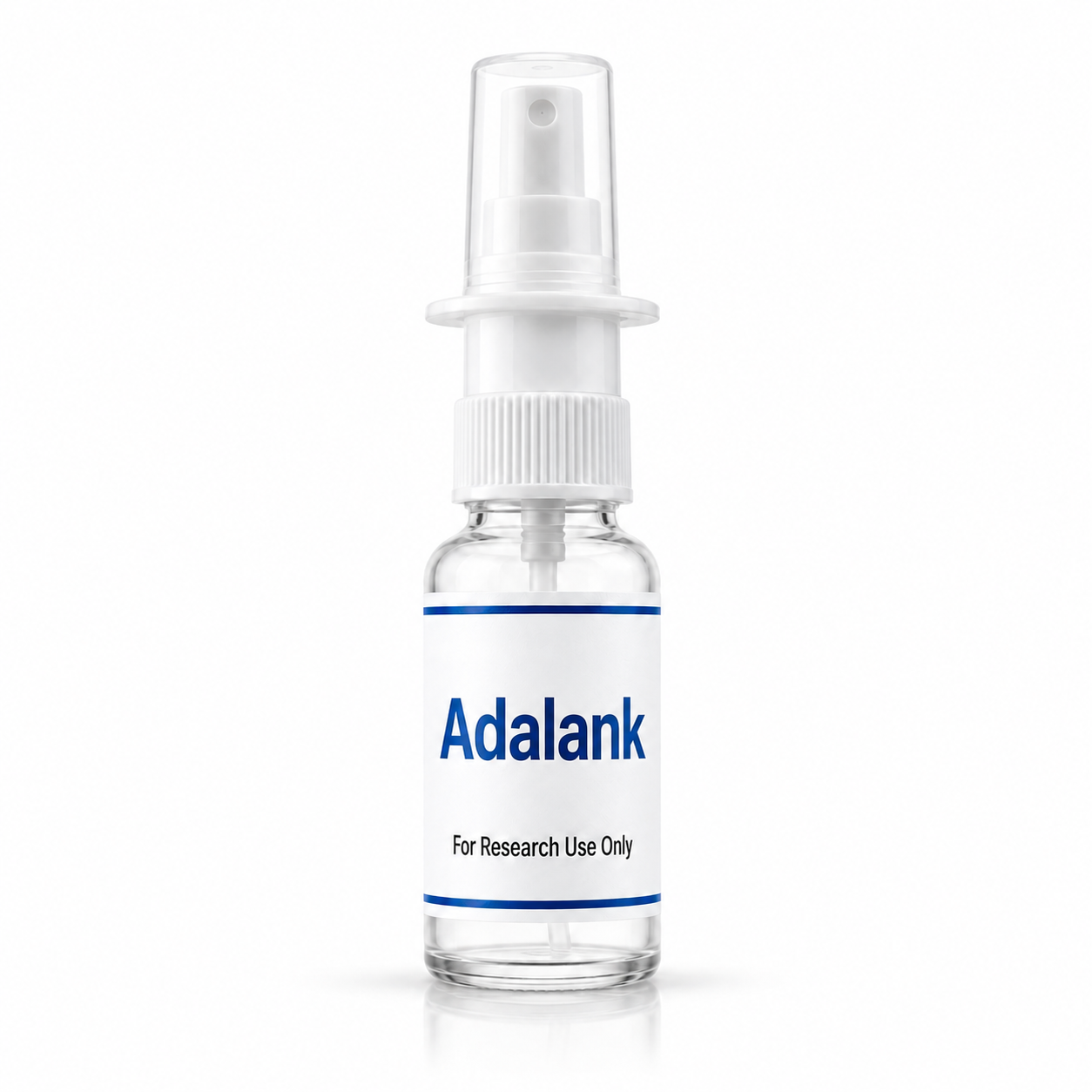
Adalank Spray
Every price, divided down to the milligram.
Sticker prices hide what a compound actually costs, because vial sizes differ. So we divide the listing by its stated peptide content and show the real cost per milligram.
Vendors pay us a commission when you buy through our links. It never changes the order — rows are sorted by measured price per mg, and every flag is computed from the data shown. Read the full disclosure
Where to buy
One listing trackedHow this page is funded: vendors listed here pay us a commission when you buy through our links. Commissions never change the ranking — rows are ordered by measured price per mg, and flags are computed from the data on this page. Sponsored placements, if any, are always labeled.
On this page
How to read these rows
Verify the COA
A certificate of analysis should come from an independent lab, reference the exact batch number on the label, and be recent. Vendor-issued documents without a named third-party lab carry less weight — the COA row links to what each vendor publishes.
Match the format
Lyophilized vials and sprays are different products with different concentrations. That is why sprays sit outside the $/mg ranking — compare vials to vials, sprays to sprays.
Count the total cost
Shipping fees, free-shipping thresholds and active discount codes can flip which vendor is actually cheapest for your order size. The $/mg figure is the baseline; the shipping and code details finish the math.
How we rank
The row below carries a price per mg figure: listed price divided by stated peptide content, excluding shipping and codes. It is the same calculation applied on every compound page, so a figure here is directly comparable to one anywhere else on the site.
We currently track a single listing for this compound. When a second vendor is added the rows are ordered by measured $/mg, and the flags for testing and shipping are computed from the data shown. Each row carries its own verification date.
About Adalank Spray
This compound has no dedicated peer-reviewed studies of its own. The mechanism and research shown below belong to its parent compound, Selank. Extrapolating that profile onto this analog is a working hypothesis, not a documented fact — the terminal modifications can change pharmacokinetics and target affinity.
Sequence
Ac-Thr-Lys-Pro-Arg-Pro-Gly-Pro-NH2 Ac-TKPRPGP-NH2
Residue count : 7, both termini capped Modifications : N-terminal acetylation of the threonine α-amino group; C-terminal amidation of the proline α-carboxyl group Parent compound : Selank (Thr-Lys-Pro-Arg-Pro-Gly-Pro) CAS Number : none assigned Class : modified regulatory heptapeptide; tuftsin derivative
Selank C33H57N11O9 751.88 g/mol + N-terminal acetyl +C2H2O +42.04 C35H59N11O10 793.92 + C-terminal amidation +N +H −O −0.98 C35H60N12O9 792.94
A second supplier publishes ~C35H60N12O9 at ~790–795 g/mol and sets out the same arithmetic (Selank core ~751.9 + acetyl +42 − amidation 1).
Another supplier publishes C35H58N12O9 at ~790.9 — two hydrogens light, and flagged on their own page as "calculated; verify against lot COA."
The method can be checked against a compound where the answer is settled. N-Acetyl Semax Amidate is Semax (C37H51N9O10S, 813.93) with the same two caps, giving C39H54N10O10S at ~855.0 — which is the value in general circulation. The same procedure applied to Selank yields C35H60N12O9.
Half-life
Native Selank is reported at 7–15 minutes in circulation. The capped analogue is reported at approximately 30–60 minutes. The entire rationale for the modification is contained in that comparison: both caps block exopeptidase attack points, and the pharmacophore core is unchanged.
Origin: tuftsin and the Pro-Gly-Pro strategy
The lineage here is specific and checkable, and it parallels Semax exactly.
Tuftsin
The natural tetrapeptide Thr-Lys-Pro-Arg, a fragment of the CH2 domain of immunoglobulin G, described in 1970 by Victor Najjar as a stimulator of phagocytosis. TKPR is the first four residues of Selank.
Selank
In the 1990s, the Myasoedov group at the Institute of Molecular Genetics, Russian Academy of Sciences, Moscow, appended the C-terminal tripeptide Pro-Gly-Pro to tuftsin, producing the heptapeptide Selank. Adding the proline tripeptide conferred proteolytic resistance and, in rodent behavioural models, an anxiolytic and nootropic profile alongside tuftsin's immunomodulatory activity. Selank was registered in the Russian Federation in 2009 as an anxiolytic nasal solution.
Adalank
The next step in the same strategy: cap both termini to further slow enzymatic degradation without altering the active core.
The same design logic, same institute
Semax ACTH(4-7) + Pro-Gly-Pro Selank Tuftsin + Pro-Gly-Pro
Two different active fragments, the same Pro-Gly-Pro stabilizing tail. That shared motif is the signature of this school of peptide design and explains why the two compounds are always sold and discussed together.
How the two analogues differ in strategy Adamax Ac-Semax + Ala-Gly extension 9 residues Adalank Ac-Selank-NH2, both termini capped 7 residues
Adamax lengthens the chain; Adalank caps the ends. Different approaches to the same stability problem.
Non-classical GABA-A modulation
The best-described mechanism and the one that differentiates the compound. Selank does not bind the benzodiazepine site. It acts indirectly — reported partly through the neuropeptide Y system — and modulates expression of GABA-A receptor subunits in frontal cortex and hippocampus.
The distinction matters: a benzodiazepine binds allosterically to a site on an existing receptor and directly potentiates its response, which is why sedation, ataxia and tolerance follow. Selank is reported to alter the level of GABAergic signalling itself through expression, with enhancement of inhibitory signalling reported in rodent models without the benzodiazepine sedative profile.
(Volkova et al., Frontiers in Pharmacology, 2016)
Reported to enhance the effect of diazepam in reducing anxiety under unpredictable chronic mild stress in rats.
(Kasian et al., Behavioural Neurology, 2017)
BDNF and NGF
Intranasal Selank reported to regulate BDNF expression in rat hippocampus in vivo. The effect is described as weaker than Semax's but consistent across animal models.
(Inozemtseva et al., 2008)
Reported protection against ethanol-induced memory impairment via regulation of BDNF content in hippocampus and prefrontal cortex.
(Kozlovskii et al., Bull Exp Biol Med, 2019)
Enkephalinase inhibition
Selank reported to inhibit enkephalin-degrading enzymes in serum and brain tissue, raising endogenous Met- and Leu-enkephalin concentrations and prolonging enkephalinergic signalling — offered as a contributing mechanism for the anxiolytic profile.
(Zozulya et al., Bull Exp Biol Med, 2001)
Monoaminergic transmission
Reported influence of Selank and tuftsin on dopamine and serotonin concentrations and their metabolites in brain structures.
(Semenova et al., 2008)
Tuftsin-like immunomodulation
As a tuftsin analogue, reported modulation of macrophage function and cytokine profile including interferons and IL-6, with antiviral activity in some animal models. Peripheral to the anxiolytic profile but relevant to inflammatory hypotheses.
(Uchakina et al., 2008; Kolomin et al., 2014)
Clinical work
Reported efficacy in generalized anxiety disorder and neurasthenia, with a comparison against phenazepam reporting comparable anxiolytic effect and tolerability. Russian-language psychiatry journals; not independently replicated outside that literature.
(Zozulia et al., 2008; Medvedev et al., 2014)
Regulatory status
Adalank is not registered as a medicinal product in the EU, the US, or any other jurisdiction. It has no assigned CAS number and no dedicated clinical literature.
Native Selank holds registration as a medicinal product in the Russian Federation only, as an anxiolytic nasal solution since 2009. That registration covers native Selank and confers nothing on the acetylated-amidated analogue, which has not undergone an independent registration pathway anywhere.
Compliance note worth carrying across
a second vendor states explicitly that describing this product as an "over-the-counter anxiolytic," "anti-stress preparation" or "anti-anxiety peptide" is contrary to the Research Use Only framework. That is a sound formulation for any page covering this compound.
Anti-doping
Selank and its analogues are not currently listed by name on the WADA prohibited list, but neuromodulatory peptides can fall under general clauses. Status may change between updates.
Material supplied for laboratory use is a research chemical. It is not a drug, food, cosmetic, or dietary supplement, has not been evaluated by the FDA, and is not intended for human or veterinary use.
Specifications
| Sequence | Ac-Thr-Lys-Pro-Arg-Pro-Gly-Pro-NH2 |
|---|---|
| One-letter | Ac-TKPRPGP-NH2 |
| Molecular formula | C35H60N12O9 |
| Molecular weight | 792.94 g/mol |
| Residue count | 7, both termini capped |
| Modifications | N-terminal acetylation; C-terminal amidation |
| Parent compound | Selank (Thr-Lys-Pro-Arg-Pro-Gly-Pro) |
| Parent formula | C33H57N11O9 · 751.88 g/mol |
| CAS Number | none assigned |
| Class | modified regulatory heptapeptide; tuftsin derivative |
| Isoelectric point | strongly basic (Lys, Arg; C-terminal amide) |
| Reported half-life | ~30–60 min (native Selank 7–15 min) |
No CAS number is assigned to this compound. The molecular formula is derived from the parent peptide Selank by adding the N-terminal acetyl group and converting the C-terminus to an amide. In-vitro / preclinical characterisation only — no clinical or therapeutic claim is expressed or implied. Research use only.
Literature — parent compound Selank
This compound has no dedicated peer-reviewed studies. Every reference below concerns the parent peptide Selank; applying its profile to the acetylated-amidated analogue is a working hypothesis, not a documented finding.